
 Jacket 34 Contents page
Jacket Homepage
Jacket 34 Contents page
Jacket Homepage
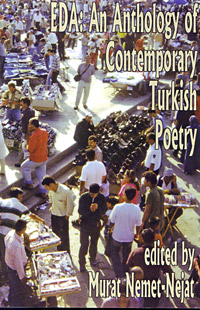
You can also read 30 pages of essays on themes raised by this anthology of poetry in this issue of Jacket.
This piece is about 70 printed pages long.
It is copyright © Murat Nemet-Nejat and the individual contributors and Jacket magazine 2007. Jacket is grateful for permission to republish this material. Unless otherwise indicated, all the following pieces are from this printed book: «Eda: A Contemporary Anthology of 20th Century Turkish Poetry» edited by Murat Nemet-Nejat. 367 pp., 2004. US$27.95. 1-58498-034-6 paper; Talisman House, P.O. Box 3157, Jersey City, New Jersey, 07303-3157, U.S.A. Email: TALISMANED[ât]aol.com
Buy the book here!
Contents: Poetry (click on the name to see the poems)
Back to Contents (top of page)
paragraph 1
That Space
Out of the sea
this thin air blowing, let it play with your hair
if you knew
one who, with the pain of yearning, looked at the setting east,
you too, with those eyes, that sadness are beautiful!
Neither you
nor I
nor that evening gathered around your beauty
nor that harbor from the sea,
for painful thoughts,
knows closely the generation unfamiliar
with melancholy.
The present
who calls you only a thin young lady
who calls me only a fool,
the calamitous appetite, this dirty stare,
can’t find in you or me
a meaning,
or in this evening a delicate
anxiety
or in the placid sea
a resentment,
a tremor of turning inward and wanting nothing.
You and I
and the sea
and this evening without tremors, silent.
sifting up as if your soul’s odor,
far
and freed from a land full of blue shadows
and in this parted space of exile forever sentenced.
That space?
Remains in the virginal, vertiginous territories of dreaming,
a blue evening
constantly resting in it.
the sea on your skirt
pitches into the soul the quiet
of sleep.
Women there are thin, pure and nocturnal,
in their eyes your melancholy,
either they are sisters or lovers,
wise to the ways of assuaging the heart
pain
or your tearful lips
or or the purple quiet of questions in your eyes,
Their souls are the condensed
violet of resentful evenings
constantly looking for
quietus.
The unlit fire of the moon’s sadness,
as if, only hidden in your hands,
they are so awkward, ah, those hands,
their dumb and partaken melancholy
and the preoccupied evening, that sick water
they all resemble each other there...
That space,
in what continent of dreams,
snaked by what what river?
Is it a lying place or true,
but an undiscoverable shelter of dreams?
Don’t know... I only know
you and I
and the blue sea
and this evening which stirs in me
the strings of melancholy and
inspiration,
far
and freed from a land full of blue shadows
and in this parted space of exile forever
sentenced.
— 1921
2
Glass
Don’t think it’s rose, or tulip,
filled with fire, don’t hold it, you burn,
this rosy glass.
Fuzuli had drunk of this fire [2]
Majnun, fallen with its elixir
into the state of this poem.
Those drinking from this cup burning
why, filling the night of love
with moans and mint, end to end
Filled with fire, don’t hold it you burn
this rosy glass.
— 1921
3
Poem
In a grieving perfection’s insomnia
why your insistence, nightingale?
listen, in the orchards of our heart
the rose you mentioned gave its life.
Spreading, the rose now in the air
in a new abundance.
— 1921
4
Ascension [3]
you’ll ascend the stairs slowly
on your skirts a golden pile of leaves
always you’ll be looking at the East crying
Always looking at the East crying to be revived
waters are yellowing ... your face paling in shadows
bending roses bleed bleeding to the ground
wait flame like on branches nightingale
has water burnt why is the marble bronze
From yellow to bronze to crimson to night is the fiery movement of the soul in its ascent.
Fire is reflected light in the evening twilight, soon to be replaced by the reflected light of the moon.
The nightingale and the branch on which it stands become one, waiting together.
wait flame like on branches nightingale
look at the crimson sky turning evening
— 1926
Back to Contents (top of page)
5
Since I Was Put... [4]
— translated by Taner Baybars
Since I was put in this hole
The earth has gone round ten times.
If you ask the Earth, it’ll say,
“don’t mention it,
such a microscopic amount of time.”
If you ask me,
“Ten years of my life.”
The day I was imprisoned
I had a small pencil
Which I used up in a week.
If you ask the pencil, it’ll say,
“My entire life time.”
If you ask me, I’ll say,
“So what, only a week.”
Osman, serving a sentence for murder
when I first came to this hole,
left after seven years and a half;
enjoyed life outside a while
then he came back for smuggling
and left at the end of six months.
Someone heard the news yesterday, he’s married.
He’ll have a child come spring.
The children conceived
the day I was put into this hole
are now celebrating their tenth year.
The foals born trembling on their thin,
long legs that very day
Must now be lazy
mares shaking their wide rumps.
But the young olive shoots are still young,
still growing.
They tell me new squares are built
in my own town since I came here.
And my family in that little house
is now living
in a street I don’t know
in a house I can’t see.
The bread was white as virgin cotton
the year I was put into this hole
and then it was rationed.
Here, in the cells,
people killed each other
for handfuls of black crumbs.
Now things are a bit better
but the bread we eat has no taste.
The year I was put into this hole
World War II hadn’t started.
In the concentration camps of Dachau
the gas ovens hadn’t been built.
The atom bomb had not exploded in Hiroshima.
Oh, time has just flown
like the blood of a butchered baby.
Now that it’s over
the American dollar
is already talking
of a third World War...
All the same, the day is brighter now
than before
when I was thrown in this hole.
Since then
my people have raised themselves
half way up on their elbows.
The earth has gone round the sun
ten times...
But I repeat with the same yearning
what I wrote for my people
ten years ago today:
“You are as plenty
as the ants in the earth
as the fish in the sea
as the birds in the sky...
You may be cowardly or brave
literate or illiterate,
and since you are the makers
or destroyers
of all deeds,
only your adventures
will be recorded in song.”
The rest,
such as my ten years’ ordeal,
is mere idle talk.
Bedri Rahmi Eyüboğlu (1913–1975) [5]
Back to Contents (top of page)
6
Black Mulberry
My black mulberry, my forked darky, my Gypsy,
My grain of pomegranate, my grain of light, my only one;
I am a tree, my limbs, a porch hanging with grapes,
I am a hive, you are my honey, my bitter honey,
My sin, my ague.
Tongue of coral, teeth of coral, thighs of oyster ,
I gave you a life, my wife,
My black mulberry, my forked darky, my Gypsy,
What more will you be to me, my odd one, queer one,
My smiling quince, my weeping pomegranate,
My baby, my stallion, my wife.
Orhan Veli Kanık (1914–1950) [6]
Back to Contents (top of page)
7
“We wish it were possible to dump even language itself.” Orhan Veli, Kanik, from the introduction to Garip (Strange)
8
Quantitative
I love beautiful women,
I also love working women;
But I love beautiful working women
More
9
Exodus I
— Translated by Talat S. Halman
From his window overlooking the roofs
The harbor was in sight
Church bells
Tolled all day long.
From his beds the trains could be heard
From time to time
And at night.
He loved a girl
Who lived in the house across the street.
Be that as it may,
He left this town
And moved to another.
— 1941
10
Poem
My friend Sabri
And I always talk
In the street at night
And always drunk.
He always says,
“I’m late for home,”
And always two loaves
Of bread under his arm.
11
The Guest
I was bored yesterday towards the evening.
Two packages of cigarettes didn’t do me a thing;
Tried to write, no good either;
For the first time in years I played the violin,
Walked around,
Kibitzed watching people play backgammon,
Sang songs off key,
Caught flies — a boxful.
Finally, damn it,
I came here to see you.
12
I Am Listening To Istanbul
I am listening to Istanbul with my eyes closed
First a breeze is blowing
And leaves swaying
Slowly on the trees;
Far, far away the bells of the
Water carriers ringing,
I am listening to Istanbul with my eyes closed.
I am listening to Istanbul with my eyes closed
A bird is passing by,
Birds are passing by, screaming, screaming,
Fish nets being withdrawn in fishing weirs,
A woman’s toe dabbling in water,
I am listening to Istanbul with my eyes closed.
I am listening,
The cool Grand Bazaar,
Mahmutpasha twittering
Full of pigeons,
Its vast courtyard,
Sounds of hammering from the docks,
In the summer breeze far, far away the odor of sweat,
I am listening.
I am listening to Istanbul with my eyes closed
The drunkenness of old times
In the wooden seaside villa with its deserted boat house
The roaring southwestern wind is trapped,
My thoughts are trapped
Listening to Istanbul with my eyes closed.
I am listening to Istanbul with my eyes closed
A coquette is passing by on the sidewalk,
Curses, songs, songs, passes;
Something is falling from your hand
To the ground,
It must be a rose.
I am listening to Istanbul with eyes closed.
I am listening to Istanbul with my eyes closed
A bird is flying round your skirt;
I know if your forehead is hot or cold
Or your lips are wet or dry;
Or if a white moon is rising above the pistachio tree
My heart’s fluttering tells me...
I am listening to Istanbul with my eyes closed.
— 1949
13
Suicide
I must die without telling anyone.
A drop of blood must be on one corner of my mouth.
Those who don’t know me
Will say,
“No doubt he loved somebody.”
Those who know me,
“Good for him. Poor man, he suffered a lot.”
But the true reason must be none of that.
14
Walking Down The Street
Walking down the street,
Realizing that I’m smiling to myself,
I smile,
Thinking that others may think
I’m mad.
15
Trip
Birch trees are beautiful.
Still
When we arrive
At the last stop
I prefer
Being a river
To being a birch tree.
16
Poem
The beautiful women thought
The love poems I wrote
Were about them,
And I always suffered
Knowing that I wrote them
To keep busy.
17
Sparrow
You pretty girl. You’re not so sweet
As the sparrow lingering
In the noose
I set upon the highest branch
Of the plum tree
In the garden
Of my youth.
18
The Parade of Love
The first one was that slender, reedy girl,
I think now she’s the wife of a merchant.
I wonder how fat she’s grown.
But still I’d like to see her very much.
It isn’t easy, first love.
........................... goes up
......................... we stood in the street
......................... even though
........... our names were written side by side on the walls
........................... in the fire.
The third was Miss Münevver, she was older than me,
As I wrote and wrote and tossed letters into her garden
She was in stitches reading them.
Remembering those letters,
I feel ashamed, as though it were today.
The fourth was wild.
She used to tell me dirty stories.
One day she undressed in front of me.
Years have passed, I still can’t forget it.
So many times it entered my dreams.
Let’s skip the fifth and come to the sixth.
Her name was Nurunnisa.
Oh, my beauty,
Oh, my brunette,
Oh, my lovely, my lovely
Nurunnisa!
The seventh was Aliye, a society woman,
But I couldn’t appreciate her very much;
Like all society women
Everything depended on earrings and fur coats.
The eighth was more or less the same shit;
Look for honor in somebody else’s wife,
But if asked of you to throw a tantrum,
Lies, fits;
Lying was second nature to her.
The name of the ninth was Ayten.
She was a belly dancer in a bar;
While working she was the slave of any man
But after work
She slept with whom she pleased.
The tenth grew smart
And left me.
She wasn’t wrong either;
Making love is the business of the rich or the idle
Or the jobless;
If two hearts get together
The world is beautiful, it’s true,
But two naked bodies
Belong in a bathtub.
The eleventh was a serious worker.
What else could she do?
She was a maid for a sadist;
Her name was Luxandra;
At night she would come to my room
And stay till morning.
She drank cognac, got drunk.
And before dawn, she went back to work.
Let’s come to the last one.
I got attached to her
The way I loved no one else.
She wasn’t only a woman, but a person.
Not foolishly after fancy manners,
Or greedy for goods and jewelry.
“If we are free” she said;
“If we are equal” she said.
She also knew how to love people
The way she loved living.
(This poem, which was found wrapped around his toothbrush after his death, is unfinished.)
Back to Contents (top of page)
19
...
branch swings in the wind [7]
let it swing in the wind
branch swings in the wind
will swing in the wind
branch swings in the wind
could branch swing in the wind
swings in the wind
was was swinging in the wind
branch swings in the wind
must swing in the wind
swings swings in the wind
didn’t branch swing in the wind
branch swings in the wind
let it swing in the wind
branch couldn’t swing in the wind
branch swings in the wind
branch swings in the wind
wasn’t swinging in the wind
branch branch swings in the wind
let let swing in the wind
couldn’t swing in the wind
...
— 1965
İlhan Berk (b.1918) [8]
Back to Contents (top of page)
20
GARDEN [9]
— translated by Önder Otçu
Wall
Door
Window
+_________________
HOME
“I am in the middle of a garden that looks like 444.”
Cansever
The house, ‘vertical creature’.
You enter the house through the garden.
But the garden does not know the house.
Nor perhaps the other way around...
How beautiful!
What’s more, the world of objects is like this.
They all gather to enjoy the unknown.
The garden’s choice has been freedom, from the very beginning.
It has the capacity of eclipsing the house,
however conspicuous the house might make itself to show off.
— I am in the garden, says the garden.
It has its own language, history, geography.
We have also come to realize that it has some peculiar thoughts of its own.
(Actually, it is through these peculiar thoughts that it takes shape.)
I SEE THE HOUSE AFTER I LEAVE THE GARDEN BEHIND.
To compare the garden and the house: the garden is wide open in the face of the close-mouthed, conservative quality the house characterizes (permeated with that despotism which wounded it long ago).
THE GARDEN DETESTS CALENDESTINE OPERATIONS
Full of sound and voices.
Its face overflowing into the street.
Offering a female reading.
To compare them, it is sexual (what is not?)
THE HOUSE IS MORE AS IF TO DIE IN THAN TO LIVE IN.
Oh garden, the muddy singer of the street.
“Dirty Child.”
Hello gardens, here I am!
...
— 1997
21
Homer’s Commentators and Slaves
What kind of a guy was Homeros,
nobody knows whether he ever lived or died.
Homeros was tall, with a long, beautiful beard, says
Procles
and adds on the blind poet, “In the world
who saw more than Homer?”
one line
then he goes on and on talking about someone nobody heard of
for pages.
What about Herodotus?
Herodotus, who always wore whites and only liked sea
paintings,
“Homer was from Smyrna,” he says,
one phrase
like Doric writing.
The Byzantine courtier Pavlos discusses him
as an astrologer
in one of his obscure poems
which starts with, “On the silver plain
of his neck,”
a poem which no more appears in anthologies
(if one doesn’t count mine).
As in ancient Aegean and ancient Lydia,
there are villages with still unknown names
Homeros is like those villages:
discovered, discovered and lost again.
Yet we know,
he never dropped him
from his hand, the atomist
Democritus.
And because slaves didn’t know reading or writing
they knew Homer
And of the Republic of Alkinoos,
mentioned in The Odyssey.
A commentary tells us that in the first editions of The Iliad,
discovered by Xenodotus of Ephesus, somewhere near Troy.
— 1978
22
I’m, Towards evening [10]
beautiful very, word beautiful, paper beautiful, pencil
I’m talking to you of rivers, of winds
For me, ... these rivers, open roads of water
When I was a kid still with a stained mouth
Walking one day I saw the rivers
Words of rivers, winds live.
I’m the leaf of your mouth, write me somewhere
Beautiful handwriting, beautiful ink, beautiful nub
Little puddles of water raised me.
To understand me ask puddles of water
Water doesn’t forget. Drawing circles, it works carefully
For me, gather leaves, stain your bed.
I’m towards evening, ruffle my hair.
— 2002
23
Fish Market, Backstage Street [11]
And so that the feet of the Sultan’s horses are not sprained, all the streets of Pera were covered with rugs. And what about Eddie the Seventh, the Prince of Wales? In his visit to Istanbul, dear Prince had attended operas at Naum twice, the Sultan Abdul Aziz sitting next to him.
24
Which today is the mansion of Sivacioglu, after this Salvo, the book store Sander, the patisserie Sembol, the shoe store D’Oree, which, I suppose, fed up being shoulder to shoulder with the hole in the wall slipper shop Martino at the tip of the street, seems always dour. The other old world denizen is the Italian restaurant Degustasyon next to the Arcade Hristaki (today, an empty lot, visited by the winds). And Degustasyon held Backstage once tightly by the hand. This is the true entry to the soul of Fish Market. And once you are in, first, flowers greet you, socks, slips, shirts, mussels, plums, cucumbers, tomatoes, thousand year old dried mackerels, blennies, plaice, Gregorian smells (do you know Gregorian smells? think of sea caves and a bit of salt and vinegar), Orthodox and Catholic faces, nylon and plastics, spices, clothing lines, tea cups, sheep lung kabobs, the Baptizer Yahya’s wild honey, sour pomegranates, hair tents, sage, rue and flies and Galata rats (which are the size of cats and dogs and look at you in this wonderful, frightening way). And everything here is standing up: those passing or approaching to sit, those flying, those talking or keeping quiet, those loitering a few feet away — everything. And, then, as if everything suddenly dropped here out of the sky and will roar back in one instant to where it came from and disappear, in fact, as if sounds started a race among all languages and do not know how to stop.
25
Backstage Street here, in this world of sounds, suddenly strutting its arms left and right, hooks itself first to the Arcade Hristaki — which old folks called the Queen, and if there is a queen in the world, she must look something like her — then to the Crepin and the Arcade of Mirrors. Fish Market is these threesome, these triplets. Of course, to them we must add Backstage Street itself and Duduoda and Nevizade Streets — these two historical relics.
26
On two feet the Arcade Hristaki today looks one foot in the grave, like buildings about to collapse. The inscription on a tilting rectangular plate points to the same thing:
27
FLOWER ARCADE REPAIRS
June 1, 1986
_____________________________
Proprietor: Niyazi Erol
Date of License: 26/5/1986
28
Whereas, once, Madame Iphigenie Espentos clothed the Sultan’s harem here, stealing down fashions from Paris. The most beautiful shops are here. The Japanese Nakamura, short and looking at you with bleary eyes and never seen sitting, exhibited his wares from Japan here. Nor did the young princes of the palace know how to leave his shop. Then, M. Perret? Who read up the French and English fashions daily? What a demon! The families of Bianci and Decugis, known never to leave their spots in front of mirrors, were clothed by him. And M. Paluka, undoubtedly the smartest dressed man of Pera, doesn’t leave this shop. Only him? This is a place where every Pera family which is anybody waits in line. Today, the Arcade Hristaki resembles something which did not have those wonderful days in its past. As if the glittering world of this beautiful, four storey Neo-Baroque building wasn’t a fact those days. Today, thinking on all those things, it keeps saying: “I died all kinds of deaths,” maybe, keeps saying to itself, “I saw half of heaven.” In this manner it is clinging, taking hold of memories. And who better than the Arcade Hristaki knows that being without memories is death. Then, fixing its eyes enviously on frozen times, Hristaki is thinking of the bar Sevic (which Osman Nihat, Salahattin Pinar and Ahmet Rasim considered their home), that’s to say, of its owner M. Hacik (who was an aficionado of the hunt, but who, unlike our revered Sultan Mehmet IV, didn’t die in his bed but hunting), of Nektar, of Degustasyon, of Palmiye, of the Ankara beer house. Let’s leave Arcade Hristaki to its thoughts. Finally, isn’t history “an interrogation of the dead”?
29
And what of the denizens of this four storey, spiral building — till yesterday, didn’t they maintain a regal life here? The Saras and Dirans of the third floor, the Iphigenies and Vartuhis of the fourth floor, the Nicolies, Luisas, Marias of the first floor? And these voices I hear now? Aren’t they their voices?
30
The Denizens of the Arcade Hristaki [12]
I don’t love evenings anymore, said Diran [13], once I used to love evenings so much
I don’t want to recollect anything. Why should one?
Everything has changed, everything left its place to a silence.
Mari hasn’t returned yet, said Iphigenie, Paluka must have closed his shop by now.
This Alba’s tits are so big, said Vartuhi, and she is only fourteen.
She is like her mother, said Marta, once in Pera her breasts had no equal.
How many times I told you to have your hair cut by Izidor, said Armaniac, it is getting on my nerves.
Everything of yours, everything gets on my nerves.
How crowded Papillon the Accessories shop is, said Glavani, there is no way explaining women.
Memories made me fat, said Diran, I don’t want to touch anything any more.
Looking out of the window is enough for me. There, Eleni is returning with her new blue bag.
She always wears high heeled shoes, she always goes out alone.
Pigmalion has changed its windows again, said Sara, stores don’t know what to do.
What’s eating you, said Martu, the whole day you keep talking like that.
What do you think? Don’t you hear, they make love upstairs every night. That’s what I am talking about, said Sara.
Then they drink Chinese tea till the evening, keep staring at the sky, I don’t understand it.
The sky, which is ribbons, rag dolls, picture books, oranges from China.
This Luisa has reached her sixties, said Duran, she still can’t keep her head out of the window.
Every night Lebon, Alkazar, Degustasion. She still hasn’t had enough of the world.
On a 78 disc, every night, every night, Hafiz Burhan, Osman Nihat, Hafiz Cemal.
Lulu has become very forgetful, said Germaine, she is asking again how much water she should add to the pilaf.
She left the house yesterday to go to Shute’s, she found herself at the church of Terre-Sainte.
We have become old, old, I can not pick two logs of wood from here to throw into the stove.
I told Yanni so many times to bring me dry wood, he doesn’t understand.
I am burning all over for quite a while, I am trembling, said Eleni, the doctor is saying I’ve got nothing.
I should go to bed early, get up early, be careful not to catch cold, I should take care of my health.
I also told him I sometimes wake up as a butterfly. Such things happen.
Look, Sara has closed her windows, said Marta, she couldn’t ever help thinking of her husband who sailed away on a banana boat.
How long Mademoisel Suzan’s neck is, said Lulu, who does she look like?
Once she didn’t give a damn about the world, she wore yellow socks and went to bed with whoever she pleased.
Ulla is shouting again from the third floor that she is going to Patisserie Markiz, said Diran.
To Markiz?, said Madame Tilla, I never liked the smell of resin.
Returning from the Royal Hotel, I saw doctor Violi, said Eleni, he didn’t recognize me.
He used to wave at me from Marta’s window, he made me laugh a lot.
His house always smelled of carnation and oil. Among the smells of carnation and oil, I used to go and come.
For months now, said Armaniac, I don’t want to go to Nektar, right under my nose. What happened to me?
Beyoğlu [14] has become a shroud now, no, is good vinegar!
See how night has come down, Diran said, we should shut the windows, night has arrived.
Night, now, everything is night, it has been so one or two hundred years, everything is night.
The world is full of loneliness, said Lulu, out of nowhere, I am watering the geraniums, I am changing clothes out of nowhere.
Oh, it doesn’t end, said Armaniac, the stinking noise downstairs, these sounds of drums and fiddles.
I can’t can’t resist looking at Margarita’s hat, umbrella, said Marco.
How she used to sit there before me and sang beautifully ballads from Tuscany.
Time doesn’t know how to pass any more: children, trees, in water those who died in water.
Matilda’s skin’s smell, said Vartuhi, more than anything, I can not forget that smell.
Her silk stockings, especially her long legs, and her sleeping with a rose in her mouth the whole night.
And now, at four o’clock, I am tossing in my bed, keep tossing in it.
This world is strangling me, this house, this window, these curtains, this toothbrush.
This is Madame Anahit’s accordion, said Matilda, I grew up with this accordion.
She is playing those lovely La Comparsitas, those tangos now to this ugly crowd.
I can’t listen any more to her peasant tunes, to her onion smelling accordion.
This city, these bells, these sounds from the radio are driving me crazy.
How right you are, said Suzan, I don’t want to see this Long Road, these trees, these people any more.
A l l t o g e t h e r
Forgive us, all of you houses, streets, people, forgive us
Forgive us, old age, forgive us.
— 1985
*The Arcade of Hristaki is an arcade in a state of ruin in Istanbul, in process of being restored. At its hey day it contained a famous whorehouse, now gone. The poem consists of a chorus of the ghosts of prostitutes who used to belong to the whorehouse, fragments of the things they uttered.
Can Yücel (1927–1999) [15]
Back to Contents (top of page)
31
A Parable
I saw Christ in a vision last night
He was the same as alive, half dead
He is standing like a specter on the raft
If you say this is the sea, it’s not, it is the Lake of Galilee
The cross is around his neck like a hanged man
As the raft rolls he sways too.
On the shore a herd of wise fishermen
Staring at the cross they get swayed too.
As you know, prophecy is also a craft
It also has a science, an art.
At first chance, he must push forward his ware
So that the demand increases, the market widens.
What’s Christ’s craft? Miracles...
The ones who know the New Testament will remember it:
The Good Lord caught fish with his cock.
Look, darling, this is the power of faith.
As he entered my dream I said to myself: “Now,
Is he going to challenge nature again?”
In fact, opening his breeches doesn’t
He hang his cock into the waters?
Of course, we got all exhausted waiting a long time,
But wasn’t it all all worth it?
But what at last did he fish out of the water?
A dried fig turned purple in the cold.
A heavenly music began to play then.
The God’s messanger delivered an angry note:
The biggest fault was in the Turkish police, it said.
When it poured Marx and Engels into the sea
The bane of Dialectic Materialism passed
From the books into the fish...
They don’t swallow now either miracles or net
Or hooks.
Then he stepped to the pavement at Kumkapi
And getting into an official car he disappeared.
Cemal Süreya (1931–1990) [16]
Back to Contents (top of page)
32
Houri’s Rose
I’m crying exactly in the middle of the rose
As I die every evening in the middle of the street
Not knowing my front from my back in the dark
As I sense, I sense the receding of your eyes
Which prop me up.
I hold back your hands, kiss them in the night
Your hands are white, again white, again white,
I’m afraid that your hands are so white
That a caboose in the station somewhat
I’m late at the station sometime
Palming the rose I’m rubbing it on my face
Which Houri dropped on the street,
My arms are broken, my wings,
In a red, catastrophic music,
At the other end of the reed
A brand new, gold toothed shyster.
— 1954
33
Dying In A Turkish Bath
Did you ever attend a public bath?
I did.
The candle near me blew out,
And I became blind.
The blue of the dome disappeared.
They relit a candle on the navel stone.
The marble was wiped clean.
I saw some of my face in it.
It was bad, something awful,
And I became blind.
I didn’t expect quite this from my face.
Did you ever sob
While covered in soap?
— 1953
34
Poem
They sheared the cloud, the cloud now is clear;
My blood spills on the ground, the cloud is modest,
Blushes
And disappears.
A man’s face shadows
In my palm;
I see it and squeeze it,
Drinking stars
From the urinal.
In a testy mood
The same mood that
Tore me apart.
His face is almost gone,
My desolation is pure,
The water is flat,
My pain is on.
— 1955
35
Muezzin
You hopped into bed,
But your hymen is on the table.
Never mind, Allah be praised.
There is more than one way to skin a cat.
Peel an orange and feed its slices to me.
I have a minaret, get hold of its charms,
Be my muezzin,
While the rain
Is pouring out in the street
And folks are keeping indoors
For their prayers.
— 1954
36
Drizzle
The stars were on the sidewalk
As if at the Prophet’s coming
Because it had drizzled the night before
Dizzy like a cloud, I left her house
Skipping, skipping on the stars
Pleased as punch in the moonlight
Playing hopscotch
As at the Prophet’s coming
Because it had drizzled the night before.
— 1953
37
Poem
Whenever we threw a cigarette into the water
It kept burning till the morning.
— 1954
38
In Your Country
The clock chimed: hmmm.
Bending my brim hat over my misery,
Out of my white insomnia,
Exile to your face,
You woman,
You were in every dark corner,
Your ghost nettled on the dead street,
A child
Sang lullabies endlessly, and a viola de
Gamba lengthened the blue smile of a young mother,
And you insisted on my love for your thin beauty,
My hope, a contention in abyss.
A lover possesses only his love,
And losing is harder than being lost,
Exile to your face, my woman!
I have not forgotten
Your eyes who are my brother,
Your forehead who is my child,
Your mouth who is my lover,
I have not forgotten your fingers
Who are my friends,
Your belly who is my wife,
Your front, your harlot’s sides,
And your back,
And all these, all these, all these
I have not forgotten, how can I forget?
Strike a match, your voice flamed in blue,
Through the bright trees, your voice, the sounds of your tongue,
Into my mouth you poured, thickly,
The secret thoughts
Of this dour-skinned, this upside-down, this strange passion,
In your poison-dripping forest, gasping,
I lived your short, terrifying reign,
My heart was entangled with the tide of your hair,
And mixed, wanting,
With the Bird Sea,
Then mixed with the Black Sea,
Then with wider waters.
At night, the moon resurrects
The minarets,
Death flies with a somewhat beauty
Through hard, Koran-selling streets
(Death flies over child-soft faces),
I passed so many times
Through my streets
Your tongue’s taste in my palate like sea-weeds,
Now misty, now blue-clear, now misty again
Like some sea-beings echoing some rabbits,
Echoing Mondays, echoing the other days,
Echoing Tuesday, Monday, Saturday and Wednesdays.
A stalk outbursts in miniature a city,
Down this stalk, round these streets, I press for you,
The world curbing circles, leaf by leaf, around you,
All thoughts of gold, the gilded coins,
And the right to press these coins,
The Euphrates,
And its sister river merging,
Dark circles in my eyes,
Trees of Babylon sapping,
The Sea of Marmara,
And the monsters in that water,
The sea crabs,
The land crabs, the sand crabs, the louse crabs,
Circling love crabs, the hermits, stoned barnacles,
Begonias, irises, castanets, all make towards you.
I who am a master in the art of complaining,
I feed with my life these falcons of sadness,
You whose alchemy, gnarled, I grasp and lose in the crowd,
Your thin waist
Drumming from here, from there,
In your lands where once joyful banquets reigned
Now big beaks of lonely hours are circling,
Now, please, once again, begin to undress
From your mouth,
Loose, once again, all your beasts upon me,
Once again, come rising from your ruins,
Come to me, once again, and disperse me.
— 1965
39
After twelve P.M.
all drinks
are wine.
— 1990
Ece Ayhan (1931–2002) [17]
Back to Contents (top of page)
40
Wall Street [18]
This walking reluctantly
pitch thought night hatless
a spiritual money exchange spinning out
sterling dollars, hard cash
cruising reluctantly this pervasive bruising
a whipped body’s recline — against weeping willow
window sockets blind to this stretched pleasure
a rationale smoking why, stripped naked, stripped this body
was whipped up — glorified morning
I returning home
below sea level, a routed team
put back my lapin gloves into the closet
wiping my sole on the stoop before crossing in
tonight I shall propose your turn to beat me
a finite stretch of time the windows of Wall Street dark for eons —
infinity marries in mourning
my civil service pocket watch is running up
my lapin gloves must be returned
tonight convert symmetry into seduction
in this soft side street-walled street — my body will be fasting
this lemon moony skin deserves a good beating
without beating this lemon moon is not possible
a psychic omelet I’ll
emerging out of reluctant infinitudes, crossing the threshold
wiping my shoes on the stoop, hatless
— 1956
41
To Trace from Hebrew
My legs are long
they are long wherever I go
wherever I go they find me
my sister in a blind alley
To trace a dove for this town
to trace the eyes of the dove
one dove
in the middle ages one dove with chalk
Along the whole wall trees cool
I am tracing a sound
I want everybody everybody to have a sound
in the dove a sound in the middle ages in my sister a sound
Wherever I go they are long
they find me from my legs always
as I trace a different voice
and a holiday full of flags in a city
in Hebrew
— 1956
42
The Nigger In A Photograph [19]
Accursed. The curse which with its curving unsheathed letter will never leave me alone, which I take everywhere, my invisible dog, the curse. Who can be friends with me? Who? It is said that I carry that monk’s blood, and with an relentless agitation I run here and there, barefoot, and on my tiny chin a big beauty spot, I am known with my covered beauty still. Like the stain in the curve of the letter U.
Flower. I began my adventures as a flower vender. Flowers and children bedecking a string, dry petals. But how I was under a spell those days. Because of a little fairy’s curse, I couldn’t be looked at. Light Maltese fevers run in empty lots in summer evenings. And endless hallucinations full of clowns run in ruins. Then a stone arched passage. I am living in the drawer of a fifty-year-old witch, nailed. Am I really? One can not tell what season it is, and I am cold. Curved like the letter U.
... I went to Jerusalem in that exile of the flower vendors and got settled in the town clock... But to remember these things, I don’t want to remember them... It had run out, the money I had saved selling flowers... This far away from Smyrna, I was pawned. Let this be the nigger in the negative of a photograph from me, will you receive it one day? I had it taken while learning Hebrew, with my invisible dog inside a Jewess. Lonely and terrible. Under a huge tree which had shed its leaves, barely touching a chair.
It is not out of pity, but I am worried it won’t pass. The curve of the letter U
43
A Blind Cat Black
An absent-minded tightrope walker comes. From the sea of late hours. Blows out a lamp. Lies down next to my weeping side, for the sake of the prophet. A blind woman downstairs. Family. She raves in a language I don’t know. On her chest a heavy butterfly, broken drawers in it. My Aunt Sadness drinks alcohol in the attic, embroiders. Expelled from many schools. A blind cat passes in the black street. In its sack a child just dead. His wings don’t fit, too big. The Old Hawker cries. A pirate ship. Has entered the port.
44
Geranium And The Child
Inside those caves, grottos of shame, full of mud, a child is still taking shelter, hopping. A Salonica [20] bundle, a matted hat, a plover. The rain bird. Condemned, on his right cheek his birthmark flower is the size of a hand. And there were next to his aunt’s geranium gardens, along the length... Apparently during autumnal dreams with the marching band of his friend and of death a child going to the island streets full of water.
The wind is dragging outside: a moldy eyed tin dragon and a rusting corpse; because, during the vows of silence, an underwater ogre always lingers. Sailors, tars are wearing silk frocks. Disguised as his timid uncle who’ll fetch him home from Salonica. But, then, in kegs with nails, in kegs with nails. Later, towards morning, an after-quiet. Navy blue. And one returns, on unshod pale and coughing horses, descending the ladder of saints, to the dark tanneries and poppy stores.
In Salonica the gates of childhood are huge, lavender and without door knobs. He will go and sleep in an elementary school, among all those shallow waters, star fish. Like the open forgotten shutters of his aunt. With the marching band of his friend and of death, the child telling, alone, the story of the cart of geraniums put out on sale on earth at night.
45
Ipecacuanha, The Emetic
The tryst in the labyrinth is slaked and duped by the divinations in sand. He was my age and a closet queen. How the horses, how the chugboats rotted in that depth.
Hysterical, he hides himself in dust with apoplectic kicks. His sword in the sheath his lust an absolute probability. I stop caring. But no one should look for each other. Passing one inevitable sea.
46
Orthodoxies III [21]
What is it saying, I wonder, the purl and stitch scarf of the boy, dancing, the silk embroidery? A bird with four legs and the face of a flower.
And a wooden pestle, dipping, dipping into his sleep of cistern rain waters. By dint of precious habit.
Let them whistle the warped tune. His soapy earrings, a lewd bathroom ditty. And, now, a tambourine and its cymbals — his music tools — dropped, lie by the side.
Altered horses are raced in every neighborhood. The face painting [22] of a virgin bride melts away to the depths of a metamorphosis.
47
Orthodoxies IX
With the flight of her brothers she could not match wings, a bird in a priory. A mistiness hammered with pain.
The harmonies of a proud major scale are heard. Gregorian variations written in thick tablatura letters.
When they arrive at the stream, she will stop for days at the bank. Couldn’t help herself, both child and a widow.
48
Orthodoxies XV
A crack of lilacs. A mask chipped off their wood. It is impenetrably wide, he understands.
Kneeling, he groans, one Benjamin. Weaned off the smell of armpits. A cup of hemlock not left around against the possibility of drink.
And there is a majolica on the mat. A fortress tower rings, of the harem’s eunuchs, washed in the flood.
Screaming, under a parasol, he adorns the portable throne. In a blackout. In his birthday suit.
And a slut is giving him a broken tipped sword. Reveals herself on the rung of a ladder. Oh, Benjamin!
Two snakes entwined, trajectories melting away at an inn. Turned around by so many bends.
In the guise of an eagle owl, bubo-bubo, the fallen Christ [23] goes out to paint the town red. And he won’t come back.
49
Orthodoxies XVI
A Byzantine trompe d’oeil. A dance. A game. The Karabitsi. [24] [25] Played on, slave boys with title deeds on, all taxes paid, play the Rubap, the three-stringed violin. The peasant reed, the lute with a leather top from Azerbaijan, the tambur. They kiss their handles.
Father Hamparsum, first inventor of musical notations among the Ottomans. Due to his true faith, his notes go straight. Thinking like an Orthodox, Armenian, he sang like an Ottoman. Hey!
Note: The poems “A Blind Cat Black,” “Geranium and the Child,”
“Ipecacuanha, the Emetic,” “Orthodoxies III,”
Orthodoxies IX,” “Orthodoxies IX,” “Orthodoxies
XV,” “Orthodoxies XVI” are not from the Eda anthology, but from A
Blind Cat Black and Orthodoxies, by Ece Ayhan, translated from the Turkish with an Afterword by Murat Nemet-Nejat, (Los Angeles: Green Integer, 1997).
See:
http://www.greeninteger.com/book.cfm?-Ece-Ayhan-Blind-Cat-Black-Orthodoxies-&BookID=146
* Jacket is the first publication of this translation.
50
from 101 and One Lines and One
I’m kissing an April cloud, your face touches me.
not rain, pine needles on the roof.
a pomegranate bursting into September is open by the sun.
your body adds the taste of water to my memories in vermilion times.
I am erasing the hoar on a plum, it breaks into storm.
from its own sound the birch tree hears the appearance of winter.
skin, the wind touching the nap of the sea back and forth.
leaning on its lianas, the wooden villa is trying to stand up.
all the mulberry leaves are in the silk, one is waiting for winter
hanging on the tiller thinking, where does the salt, the bread owe money, to the wind, to the boat, to the fish?
apples gathered in her lap, their breasts cool, the warm apples.
no needle, no bark, the pine waiting to topple, the coniferous to disappear.
the lighthouse shows the sea the red light.
the world in his bed, that’s how the poet fucks.
in the lake a reflection of stars, in the night a jonquil field.
southwest wind, southwest wind, southwest wind. and rain.
who is that in the middle of the frame of nothing, the mirror getting misty as one approaches.
the nakedness on the first day of school.
like the scissors sliding on silk, days are opening my life.
birches pitch dark against the snow, in the night snow white.
the snow penetrates the night, snow drops pierce the dark.
in the web of the meadow, sadness settles in the frost.
the lake or the sky, the daffodil or I?
returning to that old pool, your past turned to you.
everything has its silence, love’s is rambunctious and loud.
in the leaves, star showers, in the moon the traces of the snail.
this cicada, dispersing the frost, all quiet now.
the incomprehensible silence of sadness and autumn being one.
in the whirling confusion, sky snow, snow snow.
fall is arriving in a down pour, redolent grapes are now purple stains.
archipelagoes, steppes, fiords into the curvature of your body.
winter slowly is adding its salt to the days, puckering them.
nature’s letter is this, the encrusted veins of leaves in the stones.
the moon is deceiving everything it falls on, with tears.
your hair falls on me in cool cascades
our separation, the ingrown nail in my soul.
the drops of rain from the night in the golden sheaves of the fig, in the fall.
this sterile violet, if it smelled like its color, even the mountains would be subdued.
the daylight is weaker, the looker at daylight is sleepy.
two dragonflies, one on the willow branch, the other the tip of the water lily.
among the trees a skein of silk thread is unraveling, delicately in the mist.
suddenly the naked tree gives fruit in the winter. star[t]ling.
looking into the mirror try to be like yourself, my stranger.
retired to the shade of my skin, the book shut.
the stars modest... only, only showing their faces in the dark.
the sea lost, the lighthouse is shedding its light on the boy’s garden.
morning suddenly appearing, leaving the white moon behind.
flowers are so crowded, not one bee visible.
have you pined for the winter, chestnut tree, all your fruits are on the ground.
erasing all the colors, snow is descending the hill.
in the blowing of northeast wind, all the frogs are sad.
so many small fires in the horizon, are they shepherds or gods?
the world opens by the turns of the lock, like early summer.
unlucky, you could not catch the migration of the cranes, you were on a trip.
seasons are not returning or days or nights, everything is crossing in nature’s spiral, with us.
— 1996
Enis Batur (b.1952) [26]
Back to Contents (top of page)
51
Passport
Aunt Aagoni died in 78, my great uncle became quiet then, for an old man
to be alone is difficult, the year I went to law school
I went to see him first, my mom had sent dates
and a sweater — now was living in a single room, that house
on Tomtom Street doesn’t leave my eyes, wasn’t dirty, no, rather, one
could talk of an infinite vagrancy, all ready
to depart, in truth, for a place he was
late for for years.
Passport.
162938
KINGDOM OF EGYPT
no. of passport 36424
Name of Bearer Armenag Shaheniantz
National Status Egyptian Subject
Profession Sales Manager
Place and date of birth Baghdad, 1904
Domicile Cairo
Height 171 cms.
Colour of Eyes Brown
Colour of Hair Black
Countries for which this passport is valid Palestine
The validity of this passport expires 4th January 1934
unless renewed.
issued at Cairo
Date 5.1.1933
I tried conversation naturally, but as you know
beyond a certain age the weave of thought
becomes tangled, with what passes his mind at that moment
and the confined slice of the past getting mixed up, and from a system
whose logic only they could see, hallucinations were rising,
words, and a few signs.
He was fixated on Eastman’s suicide, had heard the news
in 32 when he had started working as Kodak’s
representative in Beirut, they couldn’t still comprehend
it, how could an old man turn away
from life.
He also kept saying how on December 9, 1936, he came
to Istanbul. it was a magical date
in his long migration — without him ever,
ever intending really to stay for good. Then, the enthroning of King
Farouk in Egypt, those days
in the Middle East everything was uncertain,
uncertain.
The Peele report, the hangings, hundreds of Jews and
Arabs died in the rebellion, I think also quite a few
English, the Mercedez gifted by Hitler, Kodak’s
system of management full of indecisions...
That place wasn’t for my great uncle. Your passport points to the same thing:
neither his place of birth Baghdad, nor Cairo or Beirut
where he blew, nor the place of return Istanbul,
where he settled, could contain
his migrating body. He fell as a stranger
on earth, left the same.
In his 1908 essay, Poetic Creativity and Daydreaming, on the surface
plain as a piece of dunked bread in water, for the first time
Freud pulls in child and poet in the slip-up expression
of play, the child in his play, the poet
in his writing, the neurotic
in speech release
an energy potential the ordinary mind silences
or suppresses, they are blocked
and locked.
“How possible,” he says, “forget about expression,
a poet can sense and relay certain feelings and sensations
which we wouldn’t hope to recognize
even if we encountered them,
giving us the key towards the end of the essay:
“The technique that in essence embodies
ars poetica consists in the crossing of the limits, splits
the hesitations which exist between
every “i” and the other “i”s. This is
technique’s essential function.
Along with very first pieces, the mother lode of anxiety
which accompanied them turned contradictorily
into the main engine. In reality, I had
a considerable stock of experience behind me
to enable me to move from a poetics high in abstraction
to a poetics high in narration: in an arc
starting with The Tropic of Scorpio to
Fugue, I’d both used narrative techniques and
developed spectacles. Still, the poems in The Gray Divan
constantly provided for me tortuous issues
of equilibrium between romanesque and dramatic
factors. As Freud’s concept of floating fantasy space,
completely on the nose in my opinion, interacted and was
fed by the gap between i and the other i’s
also in the same essay, on the one hand, the process of writing was getting more and more
complex, on the other hand, the very same process
was creating the poem.
Ah, if only the floating time curve which breaks out of its focus in the present
to the past or to an indefinite, desired point in the future
weaving back and forth, could limit, restrain itself to the I
writing the poem! but the i’s who are the subjects of the poem are
introducing their own arc before me, besides, the subject of the poem
is not always I, I though whichever space
I place myself — even sometimes beyond — it was always I writing the poem.
My own fantasies and those I loaded on other i’s, and sometimes
filtered became passages in one single
labyrinth.
From one end to the other, with its various sequencing,
can it be said that The Gray Divan still embodies a novelistic structure?
Emptying the bottom drawer of the dresser in the bedroom
they gave it to Vahan Bey: a roll of letters
wrapped in nylon and tied with plastic,
full of calculations — now meaningless — a notebook,
the passport and the folder of Chamber of Commerce
file came from there. I know that house
on Tomtom Street: just down the Spaniards’,
attached to the garden, a two-storey ruin, the front faces
the Palace of Justice, on one side
is the Italian Consulate — to me a dark, strange
lake with various registers of depth, when I go
down the street, reaching a certain point, a light
flashes from the small bell of the church, though I have no prayer
to say, the place I’ll pray is either on the tongue,
I descend slowly with a foreign sadness which, how could I know,
lived in that place, even if I did, what
difference. — Vahan Bey has spread
the flyers of the bank on the counter,
a few old movie posters, a pile of magazine issues serializing
The Juif Errant with illustrations is visible, next to some photographs, this antique civil servant discussing
seriously, in detail, the fine points of Bozcaada wines
with a friend, his coin purse tied with safety pin
on his coat, his clipped haired, large face cat
not leaving his feet, from where bending I pick
the passport up.
— 1997
Ahmet Güntan (b.1955) [27]
Romeo & Romeo
52
The Hour of Sleep
Seeing me he came from you
wanting himself, love, I was in you,
let him take from me, the wanter, what he wants
I am near you, I came near you, me,
hasn’t flown yet, will go then,
you, time then, for your want.
Waited for your arrival, with you,
near, next someone someone, with me
I’ll love him, he forgot it before,
Forgetting, he slept, the before, with the one there,
but he says he compares tears to me, his better self,
sleeping forget, said, hey you, the one here.
More than me you, I’ll remember, I
sleep in you, me
if you want to see, come, look where I sleep.
Romeo, my Romeo’s leaving me,
when you wake up, turn back, my lover, here, towards you,
as I sleep, me, on the road you meet, me, I’ll meet you.
I had arrived, here, I want to find, here, again,
as I wake up be near me you found me
only I love as much as you love me, you.
Don’t lie, love invisibly, me,
there where you spent the night
search me, can you sleep, then, near me, in you.
Let’s sleep, let’s, one-two-three-thirty,
four-five-six-thirty, seven-eight-nine-thirty,
ten-thirty, sleep time.
Once more, once more, once more,
I want to start from scratch.
Once more, once more, once more,
what doesn’t stop stop.
Once more, once more, once more,
what runs away, follows.
53
Lullaby
I’m with myself, alone, for myself,
walking around, me, taking you out,
who, u-turning, takes within you, me.
I won’t be, here, you,
from where you sleep, I continue, as I wake up, me,
where you forgot, I start, as I forget, you.
I won’t forget, what I forgot, fooling, you,
you forgot what you did, did me,
you sleep when I wake up, in your sleep tell me, me, what you got to tell me.
What I sleep with, before I asleep, give to me,
wake up, you I feel sleepy I must go, to me,
sleep with me, see what turns up, turns to where I turn, to you.
Sleepy, you can wait for my waking up, what it will give is me,
waiting to wake up I see, you,
in sleep, waiting waiting for your waking up, in me.
Little left, to my sleep, if you feel unsleepy, follow,
you forget what you forgot, the target in sleep, me,
what I’d forgotten I didn’t, I, you.
Once more, once more, once more,
I want to start from scratch.
Once more, once more, once more,
what doesn’t stop stop.
Once more, once more, once more,
what runs away, follows.
54
Sleep
Sleeping you depart,
forgetter of your leaving is, me
as I return from sleep, get,
you return from sleep, you.
As I return from sleep
if you return into
me, there forget
what it forgot, you.
Sleep with me, you,
in sleep you depart, from me,
in sleep I forget, I, I
depart, from you.
The sleeper departs, departer sleeps,
the mark in sleep, me,
I’ll lull to sleep,
in me, what repeats itself.
Once more, once more, once more,
I want to start from scratch.
Once more, once more, once more,
what doesn’t stop stop.
Once more, once more, once more,
what runs away, follows.
55
Dream
Looks for a simple thing: your looking for me
I do not object to, he’ll pursue his objection,
I do not look for you the way you do
me, the one I look for does exactly as I want him to, me.
Very simple, it, to me, you will show me,
as you look in your manner for me, I’ll still be there,
whatever turns up, fetch and show me,
in my searching place, I’ll find and return me.
Very simple, what I look for is pure, not in you, you aren’t in me,
come, find me, I am asleep in you,
you were fooling me in my sleep, me
from me, come, sleep in it, you, desiring me
Very simple, it’ll make me sleep, your sleep, me,
without knowing with whom I’m falling, in love with you,
didn’t catch on, someone, he is looking for me
fool him, show him, again to no one
I want to return to the beginning, once more,
lie down, if you want to forget, lie down then forget
is there someone by you who knows, who can know
you’re sleeping, now then forget me.
Once more, once more, once more,
I want to start from scratch.
Once more, once more, once more,
what doesn’t stop stop.
Once more, once more, once more,
what runs away, follows.
56
The Hour to Wake Up
Come, he said, let’s carry it together, he said.
As much as I can carry, I said.
As much as you can carry, he said.
You are leaving, don’t, stay here I said, he said
I said don’t go far he said, he says.
am not leaving, I’m staying, I said.
Sleep makes one rest he said, I said.
Sleep erases things he says he said, I said
I listen to the bitter end, I said he said he says
He opens, I said, the door, I said,
to me I said, it’s true I said.
there, I said, is visible, I said, the arriver, I said.
He’s shutting it to me, he said,
I’ll open it, don’t you worry I said, he said.
Justice Romeo!
Justice, my Romeo!
— 1995
Lale Müldür (b.1956) [28]
Back to Contents (top of page)
57
311
series 2 (turkish red) [29]
builders of the idea of turkish red
poets dervishes and wandering lovers sitting
at a drinking table based on the
refinement of ancient times
turkish red
child sultans
looking at the reds in Selçuki tiles crying
turkish red
the manner of eating oysters & serving them
the entering to the salon & the use of napkins
the liveries of the servants at the table & their from-the-right-and-the-lefts
entering the restaurant & picking a table
athenian banquet tables and Euphrates nights
as I was thinking of these thoughts
turkish red
thinking of an Azerbaijan girl
with her crescent and star earrings
I am building the
tie between
the lights of the bridge
and its shimmering
reflections in the water
seeing the water as a necklace the bridge
as a star-crescent body
(*
_____ = turk
bridge
like a bridge, departing from myself
like a Turk, red, I am crying turkish red
— 1991
58
Waking to Constantinople [30]
— to Sophie and Gérard
looking at Byzantium you are sleeping. but your tiredness is very deep.
your tiredness as deep as a long river.
pluck and throw out your heart. that’s all. that’s all. this is you.
you are hearing a sound, dark rain, an anxious sound
becomes his in the yellow moon.
and then? then you are sleeping. you are sleeping inside Byzantium. first drops
falling from votive candles are burning your eyelids. a black tramp steamer
is waiting for you in sleep. a steamer as beautiful as black death. at the edge of sleep.
if you wish from inside sleep cutting like a black wing you can reach
that steamer. but you don’t want to do that. you now on the Golden Horn on the water
are stretching one arm tied to a black steamer the other
to the well lit grief of the Tower of the Maiden. you were going to be torn
into pieces if you hadn’t woken up.
but this isn’t the first of the Byzantium dreams with Lions.
nor the last gasp of a Byzantium of being torn and waking up.
then continue your sleep for the sake of a new Byzantium awakening with Lions
but do it a little bit higher, with a bit more composure so that
the thing sliding over the gray curves, leaping over
each other, passing by in the waters of the Tower of the Maiden, no
one can tell, is it a swan or a lion? let them think it is only a fierce wind
or a shimmer drawn by an eastern comet passing on the Bosphorus years ago. but knowing eyes
those who stir history up a bit will remember:
any maiden who had a flighty tongue and required protection and was shut in the Tower of the Maiden, suddenly in an ancient Byzantium miracle would find
herself in the Byzantium dream with Lions. this way being protected
she was punished, and being punished in a miraculous Mobius reverse she was
protected again. legends say that that thing was one of
thousands of Constantinople girls who dance the hula hoop during the day
and at night had Byzantium dreams with Lions.
but for some others it could, it could only be one of the ancient Byzantium Lions
who remembered it was a maiden once and dreaming of a maiden continuously
in a sense strived to sustain her existence.
anyhow, it is clear that this Byzantium lion fading away in the waters of
the Tower of the Maiden
isn’t the one which was put right next
to the horses erected later on in Saint Marco’s Square
in Venice (horses which
also came from Byzantium).... As
history does not permit such pleasurable coincidences, the poet too
who bears the weight of writing’s responsibility
and honor, enters the scene here, ending
the Byzantium dream with Lions, aware that the few meticulous readers
who still are unable to move from pleasure principle
to reality principle and the peanut gallery
are in danger of taking seriously these narratives
of dream. yet, truly sensible readers of Ottoman Stamboul aside, other few
innocents but Byzantine readers and the mob won’t
stand their stories to be broken in the
middle, flooding the fairy tale to life, that is,
to the arenas, to the streets, will want this time to see the writer
in the Byzantium dream with Lions. And right at this point, as blues and greens are about to tear the writer into pieces, in the strange evolution of a Mobius twist, the writer finds herself inside the game she created. and the Byzantium dream with Lions continues...
you are sleeping now. you are sleeping looking at Byzantium. your tiredness
is very deep because to see Byzantium, to be able to see it took a long time. on the white
papers next to you reflected from the Venetian crystals on the ceiling bouquets of light
are falling. your eyelids are dunked in the liquid gold
of tiredness, night strewing from their edges. to remain as something
only belonging to you, not having anything taken away from you, you want to join up
the emperors of long sleep. for this you left your house, came up to Pera. sleeping now in
Byzantium’s gilded waters. you couldn’t choose a better place to live this anonym-
ity. by you there is a table clock whose tick tock can be heard. no one in the streets
now. a nightoid on his motorcycle is climbing the Galata Tower. listening to Marianne Faithful, the Boulevard of Broken Dreams...
night is long, you have no name. night is as long as the name of a Chinese restaurant — long green black yellow river... next to you is a pocket watch. why are you so
young, why are you so without worries. a voice is heard, dark rain, Byzantium, which in the silver dust moonlight later ends ups his. you wanted to pick the days you lived,
the nights, the idioms, the people, but you couldn’t, instead
looking at Byzantium you are sleeping. Zeus doesn’t blow behind your ear any more. Hermes in a reverse movement of the hand is not passing a bribe. mermaids are long dead, their corpses somewhere in the open waters of the Tower of the Maiden are drifting...
their silvery scales are withered.... a half gone voice lingering in their ears...
“Panthaselia, my wounded kid sister”... keep on drifting...
you are tired now are sleeping looking towards Byzantium are dreaming
of Tadzio from Venice, all that mystical fullness you are looking for. Tadzio is turning back
and with his index finger is pointing to the distance. now you are
having a dream. you are too remote to see the distance between Tadzio’s sign and the space between Leonardo’s mystical index fingers. Fingers in Leonardo’s paintings
point to some spot in the sky.
you are sleeping now/why you forgot that science/knew it
before/was taken long long ago/was taken from
you/maybe why now/your eyes shut/don’t hear it/yet still may be/
at a spot pointed by those fingers/you are sleeping/you aren’t far/no one is/
you never understood that Tadzio was a silhouette, a far shadow, didn’t exist,
that it only existed in proportion it was a test to put you through
a ring of fire (and that consequently you also only existed for him in the same connection), never understood
that lives should not be ruined because of Tadzios... because Tadzio is you... can only be you...
tomorrow is your birthday... tomorrow, you must wake up... must look for Tadzio in yourself...
must catch within yourself the naiveté you left behind in your sleep....
Constantinople must wake up too...,
realize that it is the Polis of Constantines... each Constantine catching the Polis
(those old sunken cities)
within himself, must let Tadzio go... must start forgetting Istanbul once was Constantinople... tomorrow is your birthday, you must wake up tomorrow. there is a pocket watch by you. why are you so young, why are you so worriless.
in the white washed and byzantine room one of the ancients is saying:
“here is a delightful balance: artist and human being
distinct and the same
both have gauged the depths
is that life is that beauty”
you are asleep now in the white washed byzantine room, you are very
alone. one of the ancients is saying, “Don’t cry.”
“Tomorrow is your birthday. Tomorrow a new name will be given to you.”
— 1991
59
The Yellowing
— translated by Maggie Dubris
the weeping sweet baby the mint leaves swirling . . .
the kids are wearing their colors baby
oh it’s only knives they’re happy
oh I forgot that song
the kids are wearing their colors baby
just don’t jump on every horse in town
that lone blown boat from the east
you learned long ago its name is sadface
oh the happy knives from the north
the blood and mint leaves swirling
in the hot copper sun
pull your hood down
in this bloodstorm baby this mintstorm
nothing matters to know nothing matters to you
you turn away you fall asleep
my sighs your lullaby my knife so sweet and true
you might be tiger butter tiger you might be hard as gold
so here — I’ll tell you what I know
get out of this bloodstorm this mintstorm
the kids are wearing their colors baby
gone to Arizona to passion and sorrow
the men wear the bucket-of-blood there baby
black heart called — adios, mis little cholos!
see I forgot how but I made my mark
with my laughing heart with my rusty knife
cause baby you’re a piss-brain if you stir it up this time
the piss-brain slides on his snakeskin baby
takes a little walk with Mister Lucky on his lips
pedal to the metal out on Route 66
the piss-brain wears beer-goggles to read with baby
has a mouthful of barfing-barfing-shoot the buffalo
in the canebrake by the lake with Night Fever playing low
but shit he’s never old he’s never old he’s never old
a lone stoned boat putt-putts through the ice
rust gets in my eyes the skies go yellow
just make my tea with tears the mint leaves swirling
call it kamikaze shaken call it pollen on the rocks
its name is loves-me loves-me loves-me loves-me-not
blues strained through yellows only leaves
and sepals sepals and hair
messy with chicky-chick of noche noche no
in a tinkling of knives
a cloud of fireflies
love showed up crackling light cracking light
I rose sadface I got
an armful of oranges
made time stop then made it go
chitchitchatchatontheyellowdaisymat
like the sun and her shadow
well love slipped out the back way
in the blast of a horn the rain of pollen
headed west into the violets
and sepals hair
matted with the chicky-chick of
y el noche noche noche
something twined around my heart
it was just a lost tornado
folding up his wings
in this cold dark forest
in this land of yellowing
ye el noche noche noche
just look at that light
it falls like gold dust through the night
...
— 1990
Back to Contents (top of page)
60
Pomegranate
Winter is too vast let’s go to the pomegranate
the surface of the day grew cold, to the pomegranates
pomegranate will have something to tell us
a thousand warm words strew from the summer
my tongue dry, from here let’s go to the pomegranate
pomegranate has a house, very crowded
I wish we lived there too
the house too big
every room a distance, children closed boxes
the back yard a chaos. When we split grapes
how we were vinyard friends, it seems,
the thief is robbing the garden
from its leaves
the vinyard
stripped naked
if the roughneck enters the pomegranate garden
sadness, fall on words prior to the skin,
before the tongue feels cold feels sad, the skin
must bloom and disperse us, going to the pomegranate
the house like pomegranate a garden inside a garden
woman, garden to love, the mad a creeping ivy woman
holding to your love, now, let’s go to the pomegranate
say, we coaxed this love from the hand of pomagrenade, let’s.
— 1997
First publication: Translation Review, no. 68, Dallas: The University of Texas at Dallas, 2004
61
Caramel
My burnt candy is hard. My life worse,
Forgetting that both come from the same shit
but I took, took to loving a woman, as life
scent of cinnamon, Carmen, oh, Carmela
she loved crème de menthe, but I compared
her to the steam from coffee and
she must have compared me to something
she took to the ache of love now she
is thrilled with leaving.
Love it seems preceded us and opened shop
early in the morning, recognized it
by its smell, its spices, its painful
words I took as the salt and pepper
of love, met her moods
in old accessory shops:
the Mirror Arcade, Bon Marche, the Gold Button...
A thousand habits, a thousand choices
clashing together,
I came across a store’s stone walls, door locked,
neither my sweet words can open it nor my moody poems,
then I found it was a caramel shop.
Now, my burnt candy is hard, my life worse,
but I am aficionado, separation is worse.
Oh, my sweet caramel, caramel is sweet but not its eaters.
— 1997
62
The Garden Hears
A gardener hears this conversation
(“what about the one who makes it heard?”)
a flower was asking the garden one night.
(“I am condemned to this because of you,
and why were you?”)
and the garden pointing to the house, it smiled
(“may be someone may need to take a flower
to the cemetery?”)
since then, as if closing the lid of a coffin,
I lock the door of the house.
— 2000
Jacket is the first publication of this poem.
Back to Contents (top of page)
63
Days
One.
First,
first.
without anything else —
being.
Seven.
heaven.
enlightenment
in the twilight mascara
of your eyes.
Eight.
according to you, a zero tightening its belt.
according to me, two zeroes kissing.
Ten.
a stick and a hoop rolling in the nocturnal meadows.
Eleven.
Sleeping back to back.
Thirteen.
I love differently, please lie a different way.
don’t wrinkle your nose — talk to me.
Fourteen.
No thirteen.
Are you dozing off or just keeping quiet?
— 1995
64
Oedipus Deboned
I heard while my dad making a date with woman at the next table
a stranger across me deboning my fish
...
Seyhan Erözçelik (b.1962) [31]
Back to Contents (top of page)
from Platonic
65
I.
The evening folded
blind, plato blind
folded.
Someone writes rain
rain
writes
rain rain.
Eyes black, yours
eyes eyes
bible black.
66
II.
Put China! Put a pinch of chinese in your eyes,
darkest inside. “puts China
in her eyes,” they’ll say, “celadon chinese
inside her eyes. Ignorant of
being porcelain. Let me move you
with care; don’t worry, don’t crack. On your
eyebrows apply
gold standard. The clock. A loop. At ten past, sixteen,
down silk ladder,
let’s.
the clock, stuck.
Ear, ring! Run
Out the loop.
Your foot slips,
the clock strikes
celadon cracks,
darkest inside,
tang!
— 1991
67
from Rosestrikes [32]
A fire in the rose.
Loves are burning.
Town is burning.
Roses don’t look alike,
many, many more in me
Count can’t endless Insects
are touring my veins,
carrying dustrose to my heart.
All the roses are growing in my heart.
A love is burning,
no water.
I’m the fire itself.
I grow bushes in me,
bushrose,
bushrose.
68
Bushrose
I suck you.
The blushrose.
The wind blows, blows.
69
Windrose
Twisted
round,
destroyrose.
Twisted
round,
back
squeezer.
Marten worships rose
sitting on my face,
Mattress turned
upside down.
70
The Walk [33]
Frost is woven with straight lines, i.e., with alifs [34]
crossing each other. Manna pouring from above. Dust and frost
oppose, dust can’t reach
the manna state without
a pour.
Alifs neutralize dust. On earth, where there is dust,
revealing a new pattern.
Alifs, aslant each other.
Double double double crossing
Sunrise — and cold — is the best place to see it.
The span of frost’s life, crossing a kid’s
gleeful heel, that is
my heel, or as long as the sun’s heat.
Frost is alive within the moon,
pursuing its own pattern.
Frost!
A frog in the soul.
The daylight approaching, the kid steps on it.
The sky breaks down.
i’m in the web
The alifs turn to dust.
The alifs which cutting please my eyes spread to the ground
chasing me
Frost bitten,
I, his innocent face
in its most fiend tormented form.
Meadow crush.
A kid’s rush.
from Coffee Grounds [35]
The coffee grounds form the fine muddy residue left in the bottom of a cup of Turkish coffee and are used (rather like tea leaves) to tell a person’s fortune. See the footnote.
71
Seven
There, a road to outside from the cup, already visible, before lifting it up. That obvious.
O.K. To where?
A shard is peeling from you, what’s unfolding on the road is it.
Two of you, sitting and talking, besides, you’re reading
his fortune. Who is a smoker, sitting in front of you, he is listening. You are reading to him, reading,
reading, so intensely that from you to him,
and him to you, something is shuttling, shuttling something
between you two.
Three roads, the middle of which is a tributary
of the road outside from the cup, you are crossing seas.
The cloud in the air is a splinter.
Like a bird with a long beautiful tail to distances, under a crescent mooned
light, the crescent moon waning for the next full moon, a wide joyful road is starting
out of the mouth, that is, you are coming out and leaving.
O.K., to where?
Not that fast. Tossing your hair, you’re also seeing off
someone, like old times precisely, with a handkerchief
in your hand, a kid next to you. But like
seeing off someone sailing on a boat.
Someone leaning on your breast. Who that one is isn’t visible,
isn’t legible. He’s holding the star in his hand.
Your fate’s in that star.
Then a rooster. A new rooster, cockadoodledooing in the moonlight.
Ushering good news. A kismet, which will please you. And a cat also is letting itself be caressed.
Every coffee ground is you.
Which are endless. [36]
Pouring what was left on the saucer back in the cup, a new fortune.
The grounds are reforming themselves.
Whichever way I may play with the cup, I can’t change
your kismet.
That’s the way the cookie crumbles...
(Ill fate, well made.)
72
Ten
Your fortune has set like the Black Sea. Untrustworthy and heavy. Let’s read.
To connive something against you, djinns are holding hands, hand in hand, have reached a decision about you. It’s such a chaotic meeting that the whole place is a mess. Sky and earth one.
You must consider, who, what these djinns might be.
Review acquaintances, relatives, when I say relative, I’m also including your mother.
Reach a decision.
This decision is on your heart, and is above your heart.
You’ll attend an important meeting.
(Here light, the Aegean light, is piercing through the cup,
with things I don’t see. I never figured cups occasionally
could be translucent. Fortune tellers also it seems
may have inauspicious days.)
In this council, be firm. They’ll try
to wheedle something out of your mouth.
Do I need to tell you that your heart is fluttering? Don’t hearts
flutter inside all coffee grounds?
Yes, but why is yours fluttering a bit differently?
Didn’t I just mention that djinns were stomping above your head, well these djinns are discussing this flutter.
In other words, something major going on. (The Aegean light doesn’t let me see it, besides, one’s fortune is illegible over water.)
Behind the swelling heart the horizon is tracing itself. (And it is vast. Is the tracing boundless, or the horizon, decide for yourself.)
I’ll get to the point. There is a sudden danger before you.
Handle it... if you can.
No roads in the near future either.
You’ll pray, did you ever imagine it? Believing that God exists in some shape, language, within the rules of a religion, you’ll pray.
Prayer, and a vow.
The coffee grounds are mixed. The Black Sea has flown, and ended. This reading has ended.
(In truth more... things under.)
73
Twelve
Of course, this fortune is a little dry, unlooked at a long time
fortunes dry, dry and crack, like lands with no water.
Yet fortunes are fortunes. Still...
From the cup to the saucer, a big chunk of coffee grounds was falling.
That is, if I had opened the cup in time, read
the fortune in due time, that block’d have slid into the saucer.
Would have.
If I had opened.
I’d have read the slipping of that mass to the saucer as an easing, as a casting
out of some distress. But when fortune freezes,
I can’t do such a reading. Because, I can’t read
the fortune of the past. No one can. This way: I’m looking at now... at the fortune
of fortune. [37]
Think also this: between the time I wrote down
and you read this fortune, the rotation of the earth completed itself
a bit more, whatever.
(Whatever which is happening, twisting and going away...)
You gave birth to this distress. (Giving birth!) Consequently,
it has gained an existence outside, independent from you. (The distress!) There is
no cord between you two. O.K.,
giving birth to the distress, did you eject the placenta also,
I can’t tell. Distress, to continue the analogy,
is fed by the placenta, finding sustenance, gaining its existence from it.
Did you start and go on a trip? You must tell me this part
yourself. (I told you, the inside of the coffee grounds has passed,
their time has passed.) But, if I’d looked at your cup in time
there’d have been a road. Yes, three roads. One towards the hills,
this you have to climb. One, towards the sky. You have, it appears,
to fly this one. Maybe you have done so. (Did you perhaps do it in your dream?)
The third, also towards the sky. But to the lands in the sky.
(Was looking at them, the coffee grounds crumbled. Of course, this is not
odd at all. I had a deja vu , but didn’t mention it.)
What else didn’t I mention?
I didn’t mention. (I see that the coffee grounds in the saucer have moulded. You know,
mold
saves lives. Wasn’t penicillin discovered that way? Wasn’t it?)
The fortune of this fortune. I snagged this one... let it be.
74
Thirteen
Lifting the cup, the saucer lifted with it then fell. This act made a sound. Before being read, fortune made a sound. Is that understood?
The mass of coffee grounds in the cup is in motion. Luck, in motion. Kismet in motion.
To where?
Towards the inside of the cup. (When I say cup, you think I mean world, yours included... don’t you?)
Fortune has stalled.
I’m looking. The moving mass of grounds looks like the Nude of Maja, reclining in bed, hands in her hair. But there is this difference: here she is mermaid. In other words: the Mermaid Nude of Maja. In an ether as comfortable as mother’s womb, she is reclining. [38]
(This mermaid isn’t you. But revealing of your spiritual state, both a child and a mother. Born and giving birth. That’s how it is.)
A slight danger, a fish’s trying to nibble pieces from this mermaid.
This danger will be averted, you won’t even notice.
Wind and sea are into each other, with places beyond the sea.
Where to?
Due to the shape of the cup I guess, a horizon in the shape of a crescent moon is also in this fortune.
Everything is so clean, so peaceful.
But in the saucer, someone is carrying a gun. What it means, I couldn’t make out. (That’s the part of fortune which was still in motion.)
Fortune has stopped.
(Coffee grounds don’t move any more.
What about kismet?)
Sami Baydar (b.1962) [39]
Back to Contents (top of page)
75
Leaves
I hold under shedding tears,
a thirst pit,
at thirty,
I arrange your neckties.
Please tell me what’s a good time for you.
From the wood a gazelle is escaping midnight
springing it back will take
tears — warped
wood after years.
Warm bread is waylaying me nowadays
as if I hallucinate a rabbit in the bush
if I merely take a walk in the field —
either way the house guest is gone (you
were used to this place, weren’t you?) —
Before leaving on the trip
checking out
the house
the windows,
the wind is
like the first stirrings of pain on the roof
first lost foreskins of living,
yet unfulfilled.
weep. weep.
— 1991
76
Water
Water boils.
It is the cloud of the sick,
the heat rises.
this fire is
this spring.
roots park
up the tree,
home
sick.
— 1985
77
Pitcher
The late ones are taken by death,
but it takes them early, before anyone arrives
the birds flocking to the first step
rains fighting in tears are guarding us
there are spins belonging to you, in the attracting
loneliness
Like a caterpillar the rain is flowing over him
snarled s o s is sending waves to the shore
rising in the throat to the surface, death
is putting on its gloves, at the depth of words
you whispered to those swimming
I’m not sore, just spinning firecrackers in my mouth,
what’s off, eye lines will true, it seems, on my part,
the broken line is vowing
revenge — waking up crying —
the letter flowing from the lip to the eye
telling its dream
On my part, I see my salvation on shoulder ends
but I can’t tell what’s in the pitcher because the wall of [40]
shoulder ends doesn’t resemble the walls in the world.
If rains fighting in tears then
like a caterpillar over the pitcher
the man asking for help
drowns.
— 1987
78
Gigi
Gigi, the angel of invisible meetings
we did so well making angels listen to music
kids are now embarrassed, of their big ears
angels are sleeping in the meadows Gigi
bored, they are weighing bird seeds
but not selling them to birds Gigi ,
I am getting by in dust and shit ,
who is attempting to remind birds
that they eat seeds,
who is laboring in the meadows Gigi,
tailors for fairy tales?
I’ll croak like an idiot Gigi
like an idiot hiding my love from you
I’ll seal you inside a wall Gigi
you’ll be invisible but people will see you
they are onto what I saw Gigi
your wish, a broken doll in the garden,
wishing me to trip and fall
don’t reveal the places I’ve been Gigi
— 1991
79
Jacket [41]
In the pocket of the jacket, a newspaper
why did they try to make them
one? Calling them lovers...
drawing two figures?
It’s not enough to be separate
maybe the cloud doesn’t believe
it, being called rain cloud,
maybe sometimes we’ll see nothing
find broken needles on the floor
rice grains.
A master key’d be nice
boards will be broken
to the line traced by a ruler
another arc will be added.
Have you ever drawn an eyelid
a lovely profile in one stroke
the weight of iron cotton
a year passing, another coming
the sky emptying
the forest is in its own room
I groped in my bed
shushed,
all together unwanted...
I prayed to those who dropped me from my crib
sat as I was told
drinking the water they were going to give me.
The cat and I
played
I detoured my dad like black bears
like a cup mowed in two
not because I knew the danger
but because, not having added sugar and
stirred it, I couldn’t empty the tea on the ground.
Two love spirits will make lamp shades out of deer legs
deer into their fabrics
a moment will vanish
they’ll grow timid in life.
besides, no one is eternally guilty these days
at the bifurcation they part
Y,
one sling,
yet
in my heart
one sling shot.
— 1996
80
Baptismal Tray
I used to collect horse chestnuts
I knew, I rolled in meadows
in hollows and projections...
which stopped them.
As half of a sliced lemon
gets moldier, forming a white line
along its edge, the holding hand-in-hand
of angels.
The rain forced to settle
inside a snail grows
field angels inside.
The girl entering a dark salon
a light, lightly, is feeling its hand on your back,
phosphorescent crayons of
erotica everywhere.
That unpossessable prepossessing sleeping child, me,
is holding a flower belonging to ancient worlds
in a book.
Drawing a baseless triangle
watching the ancient flower...
the ancient flower is signaling a flying coercion
to the candle, capsizes
scratched by bird’s feet...
Fearing that you might notice
the oddness of lines delineated in emptiness
i’m not turning in the direction of the sound, then,
as if asking you to focus at an odder thing,
I’m skipping over the candle.
(Chestnuts, moldy lemon, colored stones,
cooled waters, a dry leaf, a burnt match,
a few shining objects, a glowing lid,
snail shell, a burnt out candle...)
As you leave the child is waking:
I’m saying here I had prepared this baptismal dish
we’ll write another poem, before being turns into purity.
— 1988
81
The King’s Crown
If someone opens a window, unknown
nowhere, no time, there’s another
making him do it.
Scanning the history of symmetry, stars
observe also the king’s crown
moon and stars are only a minor circle, they say,
holding light spectrum within seven colors,
-this minimal wish isn’t for the dying —
yet greater stars aren’t bothered in this silence
one of the lowly ones takes the job.
and the servants inside your eyes
would like for a moment desist from ironing.
— 1995
82
Seagulls
Boiling in the swamp, aren’t they consolations
the finders of moonlight, piano and Roman bells?
consolations dying, lose their innocence
then one understands, “i lost my breath”
When your coffin opens, smile for the new friends
complain how hard it is to carry this to carry this
my Lord, during the moments of laughter
treat me nice
In the house of shadows, the sea gulls multiply, they multiply
lit up by your flashlight...
my eyes, wounded by these, little empty chasms open
don’t watch me, darling, watch them...
83
A Sea Bird
Towards the apex of the wave created on the
surface of the ocean, the bird
draws an arc, first is on the right side of this wave
its breast grazes the water
lifting, then the wave slides right
the bird reaches above the apex
and in the space relinquished by the wave
weaves to the highest point reached by the
cresting wave
hitting it on a tangent returns
belly first the bird is now entering the vault of the arc
scaling down in the left side of the wave
the wave progressing and passing this arc
draws a circle completed
by the bird’s belly on the surface of the water
or adding the waveless emptiness of the moment between two waves joining [2]
to the arching vault
there is always a crest left back
by a slightly sliding wave
the surface of the sea
is full of these circles of witchery
traced in the air
as a sea bird lingers on the wave
until the wave completes its circumferal motion
between two waves adds to itself
the emptying circle
of the previous wave.
— 1996
Back to Contents (top of page)
from souljam [42]
84
five
the darkling cat too needs the boy. his family locks
the pantry.
infiltration of communication by
mechanical insulation.
reconnection prowls around
defensive techniques.
85
twelve
crystals whose majority is guerillas,
full of refractions, whilst
crowds are inclinations of the like. my bequeathal
to the future as a strain
of light.
86
thirteen
as a scientist in god forsaken solitude in the genesis of light
awaiting you awaited lure of transparent insanity!
I am anteing up my concentration. my suicide
is provided for.
my sailing bags packed expertly
87
fourteen
guerilla majority of crystals,
with inherent fragility, unite!
my misfitness even
is light
mist even light. feather
and sun
...
88
forty-five
even if the whole house moves, a few curtains and laces
must linger, till the axis is broken
snapping into the nocturnal white noise consciousness of memory’s
all...
89
forty-six
a blur of moans.
let my heart beat like a rose
running fast from the scene
90
forty-seven
Chrysler in a sudden
act
of a musical rudderless
shudder
sinking through
the darker hued water —
black and white
inkar
t —
(murder
calligrams),
carrying janet leigh’s body
in the trunk
body/trunk, psychotic
you are carrying the body in the body/ the definition
of obsession.
91
forty-eight
the veiled, the one differentiated from the others, whose being kissed sets off sirens, what is his fate?
tutorial inspires erotic capture.
whispers of bravo breathe on and brush the innocent heart.
the novice’s merit badge nicks blood most often.
worm burrowing into island pantry
92
forty-nine
i realize. some of us never spawned street names.
i realize. some of us never spawned nick names.
93
fifty
the blue of the dome disappeared
tonight the path of my angels will track
through a blind
alley.
...
94
sixty
being small boned i could barely stand a kiss.
how the use of perception’s least
common denominator, which we may call linear logic,
would in what field, in which application
gain supporters for us, and how the con
of searching for consensus in the aesthetic field
and
splitting intelligence and use
from creativity, would have a historically
utilitarian function?
95
sixty-seven
i will hate the spider crawl —
ing on me. on me, i can’t kill it
96
sixty-eight
carnation crack in ice.
97
sixty-nine
what if summer’s thaw started at this critical juncture?
98
seventy
oh, left left your divine body like a broken sculpture
in my hands!
violence is the foreign tongue of the body
fragmentary improvisations of yearning
99
seventy-one
verses of adventure:
which color is blowing the dancing young man,
feet and body naked,
i can not tell.
100
seventy-two
could you understand, the curse of a course, to be read only by a compass?
101
seventy-three
spring wrote me no letters of utopias, winter did.
102
seventy-four
your loveliness is where
is missing,
where is missing
is the air!
103
seventy-five
post naked lunch
panislamic
femininity
104
seventy-six
penelope’s explosive reweaving
mystic riffs of absence
105
seventy-seven
my soul is a jelly fish, without a womb
light descends in the gutted out space of the dome.
— 1996
Back to Contents (top of page)
106
Sir, I want to write Poems with Flowers
Sir, you get angry that I write poems with flowers,
you don’t know. I hide my scattered body
behind flower curtains.
I sit in the dark, not turn on the lights.
The wound clock is ringing, ringing until unsprung.
I recall an aching love.
This is the unnecessary sheen of a knife.
I’m the illegal rain kept for years in the clouds.
Once it rains, it’ll cost you.
Sir, I’m a basement girl
whose only boss is loneliness
For now I’m solid like plastic vases
but I’m worried. In a while
in your twelve E shoes you’ll step
on kids in the garden.
This is not nice, sir.
“Day is night” I’m saying,
casting bread crumbs to birds.
They’ll eat glass shards
in my dream, in a bowl of water,
in technicolor lego blocks.
I’m trying to tell you, you won’t listen,
no, I don’t think
I can wait till the morning.
One should tell one’s dream immediately.
My soul was 14, sir,
it got older in the cold of a marble table.
Prosthetic legs were attached to my soul, delicate and white.
I walked in the city squeaking.
They even whistled at the prosthetic legs.
Meanwhile, an unarmed force in me
made of flowers was besieged,
on the screen the rustling of organza was playing.
I tried to slip away, couldn’t.
Due to that, sir, writing flower poems
from the angle of my soul I find useful.
Whatever, I remember
all the movies I see.
taking shelter in the endless night of movies.
At Sophie’s Choice I cried a lot.
If they make a movie called kissing tetras
I’ll cry there too.
Does one forget the spinning wheel inside,
besides, I’m used to remembering.
“I’m a magpie, sir.”
Sir, there are no more armadas
or sailboats.
I’ll burn a large quantity of paper.
A cormorant dove into water,
lost for a while,
even if it reemerges, having swallowed the whole world,
death isn’t too large a word, sir.
I know I smell bitter like .
But do you know the loveliness
of a lonesome love which makes scrambled eggs with sausages
at the stove and eats it?
A rose will tell a rose, if I see it,
but I’m lying
roses aren’t much for talking these days, sir.
Efe Murat Balıkçıoğlu (b.1987)
107
The Power of Self-Movement
in a wide stance, wider than what is grounded upon.
the self handling of the universally thin-edged truth.
the turned away second-coming, mentally proposed.
within the view of Asia Minor, go Westward boy.
gone to the plane, to interlaced threads away from.
the crystallized, occasional twisting of self-soul.
protuberances of your emptied body, holistically.
a plane, straight as if released, conquers the postures.
of affected beneath, beneath the healing of fatality.
God, my God, you cannot kill me, when you are dead.
— 2007
108
Friday Dust
ı
crustling towards self, bent slightly handiful.
movemental, hardening into a crust, circle.
crushing to the patternalized linearity.
helixicon versely to a point over the powermental.
quad-linearity, structural integrity, temperamental.
systematic minority brings down helixicon versatility.
anachronistically maximized nature covets natural.
integrity as self occupies self, space straightens.
a form of canonized cartilage sloughs off counter-absence.
off-nature, senses elevate upon hesitation, detrimental.
second-crossing for stretched-coming, voice resolves.
with a slanted touch, central circle makes the stretch denser.
following motion proceeds ‘honed mentality, learnt descending.
tottering, the decline of accumulated breath tightens the terse-being.
tantrum, torso-being, the bottom circling of two lobes.
sentimentally gains access to the condescendingly.
puzzling sticking-outs, tremor forebodes testimony.
tangling straightforwardness is the touchstone of equality.
floor contains what is touched, gravity contains what is added.
hybrid paralysis, nature complements the fleshly link.
once brought so far canonized and corefilled.
the abstrusely circled lobes, buttocks ready.
to be paralyzed by the diagonally stretched floor.
— 2007
Efe Murat Balıkçıoğlu wrote “The Power of Self-Movement” and “Friday Dust” in English. Jacket is the first publication of the poems.
[1] Unless otherwise indicated, all the translations of poems are by Murat Nemet-Nejat.
[2] Fuzuli: The 16th century Azeri Turkish poet who wrote Leila and Majnun. Majnun falls in love with Leila and, being refused, goes mad, begins wandering on the countryside, talks to animals, becomes a poet. Through loss (of mind and ego), tears and suffering, love becomes transformed to spiritual love. This is the central story of Turkish Sufism.
There is a confrontation at the center of Leila and Majnun. The villagers take pity on Majnun and convince Leila’s family to give her to Majnun. When he sees her in front of him in person, Majnun says, “You are not Leila,” so transformed he and she were by this suffering.
[3] Two contradictory movements occur simultaneously in “Ascension.” The ascension of the soul occurs in a language of descent, of dissolution, the end of the day, the authority of the sun (sunlight) being replaced by the spirituality, gold, bronze, crimson, of the moon. “Ascension” is an exquisite example of the simultaneity of the arc of ascent and arc of descent in Sufism (see the essays: “The Idea of a Book,” the section “Metaphysical: Sufi Contradictions and Arcs of Ascent and Descent”; “souljam/cangüncem: k. İskender’s Subjectivity,” the section “The Motions of Infinite Love.”)
[4] Nazım Hikmet spent most of his life either pursued by the police or in exile or in jail. “Since I Was Put...” belongs to the prodigious group of poems he wrote while he was in jail.
The following is a selected list of his books of poetry in English translations:
Human Landscapes from My Country, trans. Randy Blasing and Mutlu Konuk, New York: Persea Books, 2002.
Beyond the Walls: Selected Poems, trans. Ruth Christie, Richard McKane and Talat Sait Halman, London: Anvil & Yapi Kredi Yayinlari, 2002
Poems of Nazım Hikmet, trans. Randy Blasing and Mutlu Konuk, New York: Persea Books, 1994
[5] Bedri Rahmi Eyüboğlu is one of the arabesque poets; the others are Faruk Nafiz Çamlibel, Necip Fazıl Kısaürek, Cahıt Külebi. (See “The Idea of a Book”, in the section “History and Poetry.”)
[6] Orhan Veli’s poetry in English translations appears in: I, Orhan Veli: Poems by Orhan Veli, trans. Murat Nemet-Nejat, New York: Hanging Loose Press, 1989, Print225@aol.com:
To the extent that one grows to appreciate the experience of the body over rhetorical inflation, one grows to appreciate Orhan Veli. He is the poet of moment to moment experience, of eating, being in love, being bored, being sad, joking, casual musings. His poetic persona is geared to achieve this effect. His style is melted down to deal with a version of reality which is non-metaphysical, completely time-bound.... In its pared down naturalness, selection of the most immediate cadences, Orhan Veli’s colloquialism is abstract.... Outside his colloquialism, Orhan Veli’s relationship to Turkish folk poetry is overlooked. Turkish folk poetry is a poetry of repetitions, of rhymes and the repetition of lines at the end of consecutive stanzas. Orhan Veli is full of repetitions, not by rhymes or refrains, but in the form of lists or disguised lists. These repetitions give the lyrical, contemplative, paradoxically metaphysical, tone to his work.
— (Quoted from the Preface to I, Orhan Veli)
For further information on Veli’s position in Turkish Poetry see the essay “The Idea of a Book,” the section “Poetry and History.”
[7] This passage from Celâl Silay’s 1965 book Nature is drastically different from his earlier work and anticipates in sensibility the work of certain poets writing in the 1990s, particularly Ahmet Güntan’s Romeo & Romeo, and the ideas of a group of young poets in the 2000s, calling themselves the poets of the material essence, who want to inscribe into the nitty-gritty, explosive materiality of contemporary objects intimations of spiritual essence.
The relationship between the wind and branches in Silay’s poem echoes God’s relationship to the physical universe in Sufism. The cadences of the branches’s motion materially possess the intimations of a spiritual music. The dance the two lovers play around each other in Güntan’s Romeo & Romeo, the sinuous weaving between Byzantine (Orthodox Christian) and Islamic principles in Lale Müldür’s “Waking to Constantinople,” the nihilistic riffs in k. İskender’s souljam, the yearning meanderings of Seyhan Erözçelik’s Coffee Grounds are all possessed by the motions of the invisible wind in Silay’s poem.
[8] İlhan Berk’s poetry in English translations appears in:
Selected Poems by İlhan Berk, ed. Önder Otçu, Jersey City: Talisman House, 2004, TALISMANED@aol.com
For further information on Berk’s place in Turkish Poetry see the essay “The Idea of a Book,” the section “Poetry and History.”
[9] Water (harbor) and garden (house) are at the heart of the Istanbul landscape in Eda. The dialectic İlhan Berk’s “Garden” creates between the garden (and its idea) and the house (and its idea) points to the implicit shamanistic, animistic sensibility permeating the poem, in which the natural/vegetable/object and the human/man made are part of a unified motion.
[10] This blithe, lyrical poem written by a poet in his late eighties crackles with a disturbing subtext. A language of secrets, often sexual and embedded with coded revelations, is characteristic of the poetic movement The Second New, besides İlhan Berk, including the poets Cemal Süreya and Ece Ayhan. (See the essay “The Idea of a Book,” in the section “History and Poetry.”) In k. İskender’s cangüncem, the theme of child molestation, either seen from the point of view of the actor or acted upon, explodes into the open in 1990s.
[11] In Pera (1990), İlhan Berk describes almost every street in the district of Pera in Istanbul, the relationship of the streets to each other, the activities in many of the stores, etc., in detail. The passage in question describes the area which includes the Fish Market and Backstage Street. The walk that the poet takes ends up at The Arcade Hristaki, a 19th century construction, at the moment in a state of ruin and in the process of restoration. At that instant of encounter, in the next section, the streets of the present become superimposed by the voices of a previous century.
[12] In The Arcades Project, Walter Benjamin characterizes the walks through the Parisian arcades in the 19th century as a dream. As he says, “a Copernican revolution in historical perception” occurs when the idea of history as a fixed point in the past to be studied is replaced by an “awakening” in which the past and the present interpenetrate, establishing “opposing dream images.” Therefore, “politics attains primacy over history. Indeed, historical ‘facts’ become something that just now [italics my own] happened to us, just now [italics my own] struck us: to establish them is the affair of memory. And awakening is the great exemplar of memory – that occasion on which we succeed in remembering what is nearest, most obvious (in the ‘I’). [The Arcades Project, Walter Benjamin, trans. Howard Eiland and Kevin McLaughlin, The Belknap Press of Harvard University Press, Cambridge, Massachusetts, and London, England, 1999, p. 883). In İlhan Berk’s text the awakening occurs in the ghost-like voices of the denizens (the prostitutes) who inhabited a whore house in The Arcade Hristaki in days gone by.
There are exquisitely ironic and revealing parallels between Benjamin’s and Berk’s texts. A major part of The Arcades Project is made of quotations by philosophers, poets, anarchists, journalists, politicians, etc. “The Denizens of the Arcade Hristaki” is made up completely of quotations from prostitutes whiling away their time in the whore house. This points to the deeply populist strain in Eda, creating a poetry from the point of you of the sufferer, the have-not, the victim. This bottom-up sympathy constitutes Eda’s political essence.
[13]The names in “The Denizens of the Arcade Hristaki” are European/Levantine, Armenian, Italian, Jewish, etc. This was because almost all the women working in the house came from the minority groups. Pera itself was a district inhabited by the European minorities since the Ottoman times. The translation is faithful to the distortions the names undergo in their Levantine versions.
[14] Beyoğlu: the entertainment area on the European side along Istiklal Caddesi in Istanbul.
[15] Can Yücel’s poetry in English translations appears in: The Poetry of Can Yücel, trans. Feyyaz Kayacan Fergar, Istanbul: Papirüs Yayinlari, 1993.
[16] Cemal Süreya was one of the central figure in The Second New movement in Turkish literature. His work created a new language for erotic poetry. (See the essay “The Idea of a Book,” section “Hisstory and Poetry.”)
[17] Ece Ayhan’s poetry appears in English translations in: A Blind Cat Black and Orthodoxies, Ece Ayhan, trans. from Turkish with an Afterword by Murat Nemet-Nejat, Los Angeles: Sun and Moon Press, 1997, douglasmesserli@gmail.com. For further information see the essay “The Idea of a Book,” the section “History and Poetry.”
Ece Ayhan wrote A Blind Cat Black (1965) as a head district administrator in the provinces. Along with Orthodoxies (1968), each of his works redefines a poetic genre, literary language, the works becoming progressively less focused on the individual psyche and more on the myths, history of a society. But, during this process, one factor remains constant: a schism between the language of the mainstream culture and the victims, outcasts, invisibles of that culture. Each work is a poetic, stylistic taking over by the peripheral of a mainstream vehicle. In the United States the image which projects best Ece Ayhan’s poetic process and achievement is Herman Melville’s Benito Cereno, the parable of what happens to the appearance of the ship of state when subversively taken over by its slaves. (“Afterword,” A Blind Cat Black)
[18] “Wall Street,” “To Trace from Hebrew” and “Miss Kinar’s Waters” are from Miss Kinar’s Waters.
Miss Kinar’s Waters is a lyric poem with no unifying I, but atomized appearances of he’s, she’s, it’s; proper and common names merging, weaving themselves into a mournful, raging, elusive melody of the suppressed. (“Afterword,” A Blind Cat Black)
[19] “The Nigger In A Photograph” is the first of the fifteen pieces which constitute A Blind Cat Black/ Bakissiz Bir Kedi Kara. “A Blind Cat Black, “Geranium and the Child,” “Ipecacuanha, The Emetic” also are from the same book.
A Blind Cat Black is a story of exile — of an abortive coming of age — masquerading as an adventure sea romance; it is written by a poet in exile — from Istanbul — masquerading to do government service as a head district administrator.... One has a fairy tale with pirates, treasures, a la Peter Pan, whose child hero does not fly home at the end; but he joins the secret and street society of homosexuals: a fairy tale, a misadventure of trauma, shame, torture and rape in deep sea. A Blind Cat Black is the tale of the seduction and coming of age of a male prostitute. (“Afterword,” A Blind Cat Black)
[20] Before World War II, Salonica had a big Sephardic Jewish community. There was also a community of Jewish converts (donme), who lived under Islamic names. The reference in the poem is to both these populations.
[21] Orthodoxies (1968) consists of twenty-seven pieces numbered from I to XXVII.
In Orthodoxies the focus of attention is the word. The poem is a discontinuous chain of elusive images, moving vertically among the secondary, tertiary and unofficial meanings of words or their echoes.... The evocative image is often replaced by codes (usually a slang pun on the public usage of a word), mainstream vocabulary by obscure, often Greek sounding references, myth by history (a plethora of Greek, Armenian, Russian historical figures), narrative by tableau. On first view, the poem is a series of opaque images which implode against each other, like impacted teeth.... Ece Ayhan sees the word, particularly the pun — the conflict between the official and slang meanings of a word — as the place where the schism between the insider and outcast in society manifests itself. The focus on the verticalized word is a consequence of the intensely social focus of the poem. (“Afterword,” A Blind Cat Black)
[22] In villages the paint on the bride’s face is a symbol of her virginity. (from Notes, A Blind Cat Black.)
[23] Russian belief that, in the shape of a beggar, Christ will cross Russia one day. The Russians wait for him. He wanders now in the cities at night disguised as a large owl, bubo-bubo. (from Notes, A Blind Cat Black.)
[24] The Karabitsi: A Theatrical spectacle which survived from Byzantine times. (from Notes, A Blind Cat Black.)
[25] Orthodox constitutes a key pun in the poem. It refers primarily to Eastern Christian minority groups, the Armenians, Greeks and Russians, in the Turkish society, Orthodox Christianity being the Byzantine offshoot of Christianity when the schism occurred during the Roman times. By association, orthodox also means “holy, pious, virtuous.” But orthodox has a slang usage, pulling it in the opposite direction. As slang it means “whore, homosexual, pederast, betrayer, etc.” This split points to the tension between the official and underground in the Turkish culture, which Ayhan’s poem points to and reveals.
[26] Enis Batur’s poetry in English translations appears in:
Ash Divan. Selected Poems of Enis Batur, ed. Saliha Paker, trans. Clifford Enders, Saliha Paker, Selhan Savcıgil Endres, Mell Kenne, Ronald Tamplin, Coskun Yerli, Jersey City: Talisman House, 2006, TALISMANED@aol.com.
[27]See the essay, “Ahmet Güntan’s Romeo & Romeo: The Melody of Sufi Union.”
[28] Lale Müldür is a central figure in the poetic movement in the 1990s called The Poetry of Motion. (See the essay “The Idea of a Book,” section “Poetry and History.”) Besides her poems and interview which are printed in Eda: An Anthology, Müldür’s poetry in English translations appears in: Water Music, Lale Müldür, trans. Leland Bardwel et al, Dublin: Poetry Ireland Ltd./ Eigse Eireann, 1998.
[29] “series 2 (turkish red)” is from The Book of Series/ Seriler Kitabı (1991). Lale Müldür was married to a Belgian painter and spent several years in Belgium. Different color titles of the poems in The Book of Series refer to the names of specific colors in her then husband’s paint box. Words in italics in the translations mean that the words appear in the same language (English, German or Spanish ) in the originals.
[30] [“Waking to Constantinople”] is the opening salvo and, possibly, the manifesto of the poetics of motion. It is an exquisite arabesque, a supreme example of the Islamic/Ottoman sense of design and order, expressed through the image “green” and the sinuous movements, cadences of its language. The poem’s purpose is to break open the Islamic Istanbul of the last five centuries to its historical past, Constantinople, trying to create a dialectical synthesis between a Byzantine dream world (the “blue”) and Islamic rationality. The poem ends by the speaker calling for a new name for Istanbul to represent its new spiritual (and historical) consciousness.... Lale Müldür was booed and stopped when she wanted to read the poem in public in Istanbul. The fact that one of the great poems of the 20th century was booed off stage reflects the conflicting forces in Turkey and the critical position it has in our time. On the one hand, one has a majority of the population instinctively turning away from the West, insisting on the Islamic and ideological singularity, purity of Istanbul. On the other, one has a poetic and political vision, [Walter Benjamin’s “opposing dream image,”] incubated in Kemalism but different from it, which dreams of a synthesis reconciling antagonisms in a new order. It is a counter-vision to the dilemma between civil war and reconciliation which has beset many other cities in the Middle East, from Beirut to Baghdad to Tel-Aviv. (“Turkey’s Mysterious Motions and Turkish Poetry,” Bayreuth: Daily Star, November 20, 2004; U of Texas at Dallas: Translation Review, no. 68, 2004, derouen@utdallas.edu)
[31] Seyhan Erözçelik is a another central figure in the poetic movement in the 1990s called The Poetry of Motion. (See the essay “The Idea of a Book,” section “Poetry and History”)
Erözçelik’s book Rosestrikes and Coffee Grounds/ Gül ve Telve (1997) will be published in English translation by Murat Nemet-Nejat by Talisman House, Jersey City, in 2008.
[32] “A fire in the rose,” “Bushrose,” and “Windrose,” have appeared in Bombay Gin, no. 32, Boulder: The Naropa Press, 2006
[33] “The Walk” is based entirely on the pun the Turkish word “kırağı”,” which means “frost,” constitutes in Turkish. “Kırağı” is made up of the words “Kır,” meaning meadow, and “ağı,” meaning net (of). In other words, “frost” in Turkish is a “meadow-net,” a verbal ideogram. “Kır” also means both “to break” and “to hurt.” The poem transforms this double-edged meaning buried in the word into a narrative of a young kid going out in the field early in the morning and crushing the frost with his heel, the thrill the act possesses but also the undefined trauma it implies. “The Walk” is a section from the poem “Rosebud,” which is from Rosestrikes. The title “Rosebud” points to the parallel between this poem and the Orson Welles movie, Citizen Kane, the revelatory moment in the snow with the sled the film contains. Jacket is the first publication of this poem.
[34] “Alif” is the Hebrew letter “aleph” in Arabic. In Arabic it is written as a diagonal slash disappearing two-thirds down. “Aleph” is also a symbol for the infinite in Georg Cantor’s mathematics of transfinite sets.
[35] Coffee Grounds is made of twenty-four coffee-cup readings. The phrase ‘coffee grounds’ here does not refer to coffee beans ground for use in an espresso machine, coffee plunger or drip filter, then discarded. These coffee grounds are quite different: they form the fine muddy residue left in the bottom of a cup of Turkish coffee and are used (rather like tea leaves) to tell a person’s fortune. See below.
[36] Like Turkish coffee grounds themselves, fate is splintered into different words,: coffee grounds, fortune, luck, kismet, rooster, dolphin, cat, fox. One can see in this language its animistic, Central Asian origins.
Fate as a unifying concept is not spelled out, but referred to obliquely in its different manifestations, an unnamed core around which the coffee grounds weave their infinite pattern.
[37] Water is time, the mysterious catalyst in the fate of coffee grounds. What determines the fate of an arrangement, its reading? The drinker of Turkish coffee, the cadence and strength of the lips, as they sip the coffee, how far to the drains, how much liquid is left in the cup. The drinker then turns down the cup (like cutting a deck of cards). How long does the turned down cup lie fallow, the fine grounds trickling down along the sides of the cup. As water dries, the fortune sets; once set, they can only crumble.
Then the reader interprets the coffee grounds.
A coffee grounds reading is a spirit echo of the world, consisting of the same four elements: earth, the coffee grounds; water, the liquid in which they move (time); wind, the voice of the reader; and fire, the urgent queries of the listener (also moon, his/her passion) which try to rush the dilatory rhythm of fortune, its telling.
[38] Animal spirits populate this universe: cats, roosters, fish, dolphins, mermaids, mountains (also infused with animal spirits), the sea, the sky, the crescent moon, all contained within the immensity of the arc of the horizon, which is also the dome of the coffee cup, which is the dome of the sky.
The coffee cup, the universe. The fortune of a specific arrangement, determined by a fusion of the drinker of the coffee and the reader of the grounds. Fate is a fusion of being and looking at that being; one reveals oneself by looking at others, using the universe as a mirror.
[39] In Sami Baydar, water, the ego and language are one. His poetry delineates the contours of the spirit as the self disintegrates –through tears/water — to open itself to a spiritual essence. This is Sufi poetry in extremis, the nothingness, annihilation accompanying illumination.
[40] I can’t tell what’s in the pitcher: Water in a pitcher is invisible; one can only see its contours ("shoulders," "walls"). A poem almost beyond speech. To know what is inside the pitcher, one has to drown; the poem is made of cadences towards that state, delineating through tears (“caterpillar rain”) the contours of the soul.
[41] Jacket: Human life is a jacket where the wearer (the soul) is not visible. The Sufi poem is the poetry of contours. Eda is the calligraphy tracing its energy field, as the human soul breaks and heads back to God.
[42] Composed of six hundred and forty eight fragments, souljam [1996] is simultaneously the most anarchic and mystical of Turkish poems. The contradictory impulses of Turkey coexist in this poem in their most violent and extreme forms, nevertheless, in exquisite balance. Culled from entries in a journal the poet kept from 1984 to 1993, the arrangement of fragments seems arbitrary, following the subjectivity of the poet’s mind: an expression of exploding chaos. On the other hand, a yearning spirit permeates the poem, across fragments, suggesting that the seeming chaos belongs to one single mind, that the chaos is illusionary, its subjectivity divine.
...
“Souljam” is the nihilistic expression of a deeply religious sensibility. While militantly gay and full of blasphemies, the underlying emotion is a yearning love. Stylistically, also, the poem pulls in East and West in extreme incarnations. Ottoman poetic turns of phrases, pop references and scientific arguments “jam” (both in a musical sense and the sense of violence) in a fertile eclecticism, a cauldron of thoughts and feelings. (“Turkey’s Mysterious Motions and Turkish Poetry,” Bayreuth: Daily Star, November 20, 2004)

Murat Nemet-Nejat
Murat Nemet-Nejat graduated from Robert College in Turkey and studied
literature at Amherst College and Columbia University. Married, with two
children, he has lived in the United States since 1959.
Murat Nemet-Nejat’s work includes: “”I Did My Best Work During a
Writer’s Block, First Intensity, 2008; Possibilities of Istanbul (a visual and textual approach), Nina Reisinger, Austria, 2006; “Rooster Street ,” Both Both, 2006; “Eleven Septembers Later: Readings of Benjamin Hollander’s Vigilance,” Beyond Baroque Books, 2005; Eda: An Anthology of Contemporary Turkish Poetry, Talisman House, 2004; Frédéric Brenner. Diaspora: homelands in exile, voices
(essays), HarperCollins Publishers, 2003; The Peripheral Space of
Photography, Green Integer Press, 2003; “Steps,”Mirage, 2003; “A 13th Century Dream,” Cipher Journal, 2002,
http://www.cipherjournal.com/html/13th_century_dream.html;
Aishe Series and Other Harbor Poems, 2001; Io’s Song, 1998;
Ece Ayhan. A Blind Cat Black and Orthodoxies. Los Angeles: Sun & Moon
Press, 1997; “Questions of Accent,” The Exquisite Corpse,
1993, also in Thus Spake the Corpse: An Exquisite Corpse Reader (1988–98), Volume I, Poetry and Essays (Santa Rosa: Black Sparrow Press, 1999); see
http://www.cs.rpi.edu/~sibel/poetry/poems/murat_nemet_nejat/essay/questions_of_accent.html;
Turkish Voices (see this website: http://www.cs.rpi.edu/~sibel/poetry/books/turkish_voices/), The World, 1992; Veli, Orhan. I,
Orhan Veli. New York: Hanging Loose Press, 1989; The Bridge. London:
Martin Brian & O’Keeffe, Ltd., 1977. “Automic Piles” (a science-fictin essay), 1983 (see http://ziyalan.com/marmara/murat_nemet-nejat2.html.
For the last three years Murat Nemet-Nejat has been working on a long poem The Structure of Escape. He is also currently translating the Turkish poet Seyhan Erozçelik’s book Rosestrikes and Coffee Grinds (Gül ve Telve) in its entirety, which will be published by Talisman House in 2008.
The Internet address of this page is http://jacketmagazine.com/34/eda-poems.shtml