
| Jacket 35 — Early 2008 | Jacket 35 Contents page | Jacket Homepage | Search Jacket |
This piece is about 70 printed pages long. It is copyright © Robert Grenier and Charles Bernstein and Jacket magazine 2008.
The Internet address of this page is http://jacketmagazine.com/35/iv-grenier-ivb-bernstein.shtml

JACKET
INTERVIEW
Robert Grenier
in conversation with
Charles Bernstein
By email, 2007
Note: the dates that follow are in US American format, that is:
month/ day/ year : 2/22/07
Hi Charles !
paragraph 1
[I bet you’d probably rather ‘be in the Adirondacks’ but Susie is here w/ her laptop, so ‘here we go’ (?) !]
2
Waking up, as I do, at 4 a.m. (or 4:30) one night (day), I thought what can I do (w/ this ‘life time’)–‘help anyone’ ? (that’s what Larry Eigner was reported to have asked Charles O. in a Maximus, or (even more ‘negatively’) ‘Why don’t your poems help anyone?’, as you prob. recall)–save being dumb-founded/half-awake in the dark, I started rubbing my palms together (sitting up in bed w/ glass of ice water against pillows/back (West) wall) in various ways that made a (dried-out) rhythm/rhythms–wch I carried through for a while (‘w/out reason’–except to hear/make that sound)–the sound of (variously) rubbing dried-out palms together, to make some sounds–wch I ‘repeated’/‘varied’, once patterns were identified–for existential pleasure of ‘composing’/making sounds (& listening to the sounds around!) entirely devoted to ‘no-reasonance’ beyond themselves (‘for itself’ & ‘in itself’ !)... I thought [& think tonight, copying this from my ‘longhand’ for you] why not
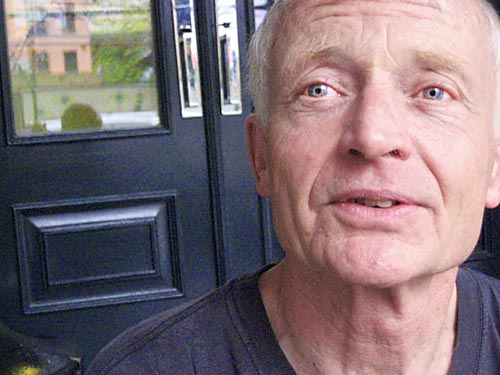
Robert Grenier, New York City, 2006, by Charles Bernstein.
Photo copyright © Charles Bernstein, 2006, 2008. Used with permission.
3
‘abandon meaning’, in favor of some of these fundamental pleasures, while living...
4
Soon tiring of that, I sat there, hoping to ‘get sleepy’–whereupon, having a sip of ice water, me bethink’st I saw some ‘glimmer of light in the East’ (or maybe it was ‘Dawn’, come to relieve me of my sleeplessness!)–turning left to my (North) side, it was there, too ! (hmmm)–then I ‘saw’ it as ‘Moonlight’ (from a possible late risen last Moon), but there was no ‘evidence of the Moon’ from where I sat upright against the west wall of the house... ? ? I decided ‘Day was coming’ & leaning back toward nodding off, something ‘moved me’ to stand & move into the bathroom toward other (‘front’) room–& there it Was coming through plexiglass front door, the 1/16th Moon, just risen off the Ridge, enough to make light–before/together w/ now the encompassing/surrounding horizon light of the new day coming...
5
And the thing is (after I ‘opened the front door’ to see the ‘rest O’ the Moon’ clearly (so much ‘bigger’ than that little lit ‘sliver’ !) & came back inside & moved to the right/looking out because wall by door blocked light I realized that against that dark wall (inside)(I couldn’t see it at all, but ‘knew’ it ‘was there’)–exactly in front of where I knew ‘Old Moon’ must be (tho wall blocked all that!) was drawing poem
6

Figure 1
7
framed, & ‘positioned’ (clearly?) in advance, in ‘anticipation’ of just such an ‘event’ (‘scripted in advance’?)...
8
Opposite sd poem-on-interior-wall is ‘other one’ (on the West Wall of my bedroom, above where I’d been sitting), equally framed & reading
9

Figure 2
10
–toward direction (but on interior wall, wch blocks sunshine entirely) from which Sun does shine, as it has that angle in to (West) exterior wall of sd house, almost every (‘sunshiny’) Afternoon !
11
And so, my first question to you, Charles, is–given all of the above (!)–is there any ‘need’ for the poem (to ‘make clear’ to ‘Itself’ what is already happening ‘by itself’–or maybe somehow it’s Heidegger’s “letting-lie-together-before” wch the Logos does (via human Wording) & is (somehow) ‘necessary’ to ‘manifestation’ of ‘what shows itself’)–OR are all these ‘images of disaster etc. we poets are ‘creating’ just PUFF (entertaining visions of DOOM/boom) the actual circumstance don’t need in order to accomplish its seemingly-‘pre-programmed’ effort toward profoundly more terrifying CATACLYSM ! ??
12
I wonder ‘what it means’ that the (unseen) poem
13
MOON
IT’S
THE
RE
[see figure 1]
14
WAS ‘there’ (unseen) against (opaque) east wall of front room when Moon rose... what ‘that’ might signify... Love, Bob
15
P.S. Even if the Answer is–the World is what (WE SAY) is the Case (as during plans for invasion of Iraq)[wch is not ‘strictly Heideggerian’ !][what abt saying how Susie came down corridor toward me (‘dazed’) after having got off plane... ? ?]–what about these ‘core-deciding’ recognitions that you get (esp. as a young poet/in yr 20’s) that the World is ‘giving Itself to me’ to be said/giggling its (Attractive) End-Of-The-World-type statement for my contemporary rendition–but I want to emphasize Spring Coming, in the White Blossoms of the PLUM TREES... ? ?
16
P.P.S. The ‘predictive value’ of both poems [FRAMED] on their walls was NIL (since both had been previously positioned in anticipation of just such an event), but to see that last little bit of waning Moon was There–‘Out There’ (on the ‘other side’ of the Wall & my [‘unseen’!] ‘Picture-in-Words’ ! !) ! ! !
17
WHY BOTHER (if it’s all to EXPLODE/BURN etc.) lettering (“for the fun of it”–LZ) my ‘local’/‘everyday’ happening/happenstance ? ?
18
[Of course, you (from ‘your perspective’) may very well want to ‘take issue’ with more than one of the Assumptions underlying parts of the above, e.g. that there cd be a ‘predictive’/‘Prophetic’ relation btwn certain verbal constructs & Anything Outside Words, or (2) even that there might be anything like ‘correspondence’ in any meaningful sense btwn ‘words’ & ‘things’ elsewise–& here, for me, possibly interesting ‘dialogue’ re the drawing poems may open up... ? ?] Write me, please, when you can, & I’ll answer ! (let’s use Susie’s email)
Bob
Dear Bob,
19
The two works of Walter Benjamin that most speak to me of the experience of correspondence you write about are “On Language as Such and the Language of Man” (1916) and “Doctrine of the Similar” (1933). I’m wondering if those essays resonate for you.
20
The other thing I have been thinking about–and it all revolves around my seminar this semester, on “The Poetry of Sound / The Sound of Poetry”–is the moment in Adorno and Horkheimer’s Dialectic of Enlightenment where they talk about the difference between Odysseus having his charges bind him to the mast so he may hear, but not heed, the sound of the Sirens, and the situation of those charges (those subjected to rules) who have their ears stuffed with wax, so they hear the Sirens not at all. “No one listens to poetry”: they can’t if their ears are sealed.
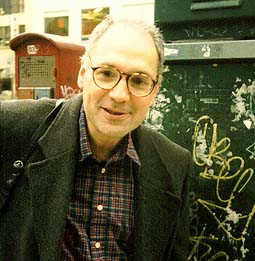
Charles Bernstein, New York City, November 1997, photo by John Tranter
21
Is Odysseus the symbol of the poet who hears, full well, the call of a sublime reconnection or merging, but who is able to resist succumbing to it by a simple act of constraint, of artifice, of alienation? That lets him–us–me–continue to write in the face of this separation or disconnection, where the writing is the mark of this–is it yearning or loss, desire or failure? If self-consciousness were obliterated, or the anxiety of separation overcome ... would we still write? A couple of days ago Nick Piombino was questioning my–what–standing schtick, that if anxiety fuels poetry then to be calm, to be in one’s right mind, could not be the objective of a poet, whose rhythms may come from moving from right to wrong mindedness, or better from right to no mindedness, the oscillation, fort/da–
22
now here
not there
now gone
now come
23
as I have it in a passage from Shadowtime that Barbara Cole printed, in this form, on a broadside.
24
But the problem is, the problem is not psychological, it’s ontological. As Thoreau writes in Walden (“Solitude”), “With thinking we may be beside ourselves in a sane sense.”
25
By a conscious effort of the mind we can stand aloof from actions and their consequences; and all things, good and bad, go by us like a torrent. We are not wholly involved in Nature. I may be either the driftwood in the stream, or Indra in the sky looking down on it. I may be affected by a theatrical exhibition; on the other hand, I may not be affected by an actual event which appears to concern me much more. I only know myself as a human entity; the scene, so to speak, of thoughts and affections; and am sensible of a certain doubleness by which I can stand as remote from myself as from another. However intense my experience, I am conscious of the presence and criticism of a part of me, which, as it were, is not a part of me, but spectator, sharing no experience, but taking note of it, and that is no more I than it is you. When the play, it may be the tragedy, of life is over, the spectator goes his way. It was a kind of fiction, a work of the imagination only, so far as he was concerned. This doubleness may easily make us poor neighbors and friends sometimes.
26
As they say, you can’t help someone else if you can’t help yourself; and you can’t help yourself unless you know how to help someone else, or help yourself as if you were someone else.
27
Should Odysseus have cut his ropes and jumped into the water abandoning himself to the Siren’s song. Would you? Do you?
28
Or is this story of Odysseus the very model for how to write a helpful poem.
29
I am sitting on a reclining chair with my laptop, lost in the Adirondacks of my mind, compass broke, but, at least, with your temporary address.
love,
Charles
Dear Charles —
30
Thanks for calling ! I’d like to ‘get started’ (again!) on this ‘communication among us’ again as soon as possible (unfortunately, I was ‘otherwise engaged’, & now you are in China??) ! On the other hand, I hope, there is no ‘great urgency’, other than ‘fact’ of being alive w/ ‘opportunity’ to communicate (wow, what might we not want to talk about, in this medium?!)–let’s write whatever we can !!
31
It’s true, the Benjamin was ‘something beyond my knowing’, but I settled in to read it because you had given it me to read (at Susie’s, I found her copy of Reflections & read there “Hashish in Marseilles” (I continue to be troubled by fact that, apparently, “Marseilles” & “Marseille” are the ‘same thing’ & that nobody is troubled by this!) & found that entirely engaging (rather like ‘romantic nostalgia’ I felt when I bought–on the spur of the moment!–Huston Smith’s collection of his note/essays on “the religious significance of entheogenic plants and chemicals” (Cleansing The Doors Of Perception) at Moe’s Books in Berkeley the other night (I SAW BOOKS as ‘wonderful’/very-likely-not-going-to-be-there anymore, & so began buying ALL OF THEM!)
Dear Charles —
32
At that point, my screen ‘froze’ & (tho I had been ardently saving every next line, in anticipation of just such an ‘event’, I admit I forgot to do so, & so of course the screen froze!) & I ‘lost’ (from memory too!) 3—4 crucial lines of/from whatever-it-was-I-was-trying-to-communicate-to-you ! !
33
So you see there’s a ‘problem’–my MACHINE, at home, freezes all the time, for ‘no reason’ (it needs a computer doctor!), & it’s not connected to the Internet because of the fee–that means going to the library in Stinson Beach (where, by reservation, I can get on a computer for 1 hour or more, ‘unpredictably’, depending on the local user demand for computer & who the librarian is that day–Kerry Livingston is my friend!) & copying what I had written in this ‘new format’ ALL OVER, in the time given, is hard–FURTHERMORE, tho perhaps some day it may be otherwise (tho you yourself must by now have become not only ‘used’ but ‘accomplished’ in this form/circumstance), I have trouble thinking that I’m ‘speaking to you’ when I’m sitting in my chair in front of this machine-whose-fan-whirrs (!)–I very much enjoyed & ‘experienced’ our conversations on the radio ‘in real time’ (& otherwise I’m used to using this computer as a typewriter–not in communication w/ anybody but the ‘page’/screen & my brain), but I can’t type fast enough to think properly to (somehow) imagine I’m ‘in a conversation’ (as I imagine you can??) with YOU, unfortunately (this contributes substantially to ‘our lack of progress’–& it’s ALL MY FAULT ! !
34
Your Being in China (your preparations for/going to China etc.) cd not possibly have been cause of our ‘lack of progress’ in this matter (so absolve yrself of any ‘lack of responsibility’ or interest to proceed, IN RE THE MATTER OF ROBERT GRENIER DRAWING POEMS vs. THE UNITED STATES ! !).
35
There probably is a ‘political dimension’ to my work.
36
Anyway (over against my original hope, that we might ‘communicate ordinarily’/think-as-part-of-a-process of more-or-less-immediately-shared-thinkings-wch doesn’t seem now that easy for me), maybe we shd ‘revert’ to strange/direct questions (wch cd be ‘answered’ whenever one felt like answering them, or not ever answered–like “Why Is The Word (pronounced) “Answer” Spelled So Strangely–w/ the “w” included??”)(I don’t have ‘time’ to read-any-more-books to find out the ‘answers’ !)–let’s just think that we’re writing letters (wch take quite a lot of time to travel) in wch we try to say ‘what we think’ abt whatever arises ‘of Itself’, to be asked (& testified to) at this time of life, in relation to the drawing poems–
37
For example, one might wonder (‘you’ or ‘me’, or ‘the general reader’–of wch at this point there are more-than-one) why we might not attempt to answer some fundamental questions before we die (entirely at each’s leisure or inclination) ‘relative’ to the poem:
38
I propose only certain ones (wch ‘repeat themselves’ for me–ET VOUS ??)–& I’d like to try to do this ‘de novo’ (however absurd that must seem–as if neither you nor I had never/ever ‘read anything’!)–you see, the ‘problem’ w/ yr Benjamin is that I had never read that, & therefore (tho it was ‘at the tip of yr tongue’) it meant immediate ‘study’ for me & ‘concentration’ & stopped thought, in this other dimension of the drawing poems (I was also interrupted by an immediate personal dilemma!), as you seemed to have de/divined (?) ! !
39
1) What is the ‘basic physical organizational structure’ for the enactment/‘realization’ of these ‘poems’ (why are they ‘poems’?) ?
40
2) What materials are ‘necessary’ for these drawing poems to ‘come into existence’–i.e. not only ‘pens & pencils, paper’ etc. but material conditions in the world of the poet ?
41
3) Why is there so much (apparent!) emphasis on ‘the handwriting of the poet’ ?–isn’t that just a fetishizing of this guy’s script (as if the labor of unravelling the letters here realized was somehow ‘worth it’–over against just being given the words we all know & use anyway & are perfectly familiar w/ the meanings of (?) in ‘print’)–what an asshole, to presume this stupid decipherment of perfectly ordinary letters, in order to figure out what’s being said by these commonplace poems–everybody knows the Moon ‘rises’, e.g. ??
42
4) Why is there so much evident emphasis on ‘the poem itself’ (its existence in-itself) as the thing brought forward, rather than the opinion of the author on matters of local & national significance (is this not a ‘snub’ of you & me ?) ??
43
5) I would like to read these poems (I think!), but I am discouraged by the difficulty (I’ve tried!) & wonder why I shd not give up altogether (I do have stuff to do!) ?
44
6) The poet has opined that these weird (‘idiosyncratic’) organizations of letters in space (in his strange but at-times-exact handwriting) may have some ‘immediate connection’ to ‘something other than themselves’, which they ‘mean & call forward’–what is the scientific basis for that assertion ?
45
7) If the Moon rises (as indeed the full moon in June is doing tonight), what ‘need’ hath it of any human language (letter-formation) to enact its occasion (the ‘fact’ of it), to mark, celebrate or revile it ? ? Such a question appears senseless.
46
8) (A ‘daytime’ variant of #7!) If a text ‘says’ (draws out over 4 lines in 4-color-funny-script-exactly-written)(in translation) the following: “AFTER / NOON / SUN / SHINE”, what ‘need’ has that actual afternoon sunshine of the ‘poem’ on this occasion to ‘say’ ‘it’ (presuming it’s not to be a ‘copy-relation’ between the ‘thing seen’ & its ‘envisionment in words’, wch can’t be) ? Such a question appears nonsense.
47
9) His squiggles, put forward as ‘art’–hasn’t that already been done quite adequately (& w/ a bit more feeling) by Cy Twombly ?
48
10) The ‘relation’ between the ‘word’ & the ‘thing’–what if it’s not a ‘relation’ but a simultaneity of occasion in which the ‘thing’ names the ‘word’ (‘for it’) ? (How can that be ?) MEOOWWW !
49
11) I really would like to learn to enjoy this author’s works a bit better than I do. Not w/ any real interest, but w/ a desire to further the discussion, since we’re all here, I want to ask whether it makes any real difference that what we have here is the 4 colors–why has Grenier not simply written his poems in one ink (e.g. black) ? That way (&/or if he presented us w/ a readable computer version, for example!), I might find myself wanting to read him, to find out what he has to say !
50
12) “All it takes is sympathetically considered longhand,” one of his affectionates sd to me, “to hear/see the ‘letting-lie-together’ of the letter-elements into words wch ‘say what they say’ is happening...” Has my friend been ‘brainwashed’ ??
51
13) Perhaps our author has confused the pleasure of his drawing letters w/ a large/great/purported manifold significance beyond that act (fun-as-it-was, for him!) ? Is that possible ? ?
52
14) I am getting old ! I don’t have time to waste trying to decipher these indecipherable figurations–I want to know what life is about (& quickly!) ! ! — Who needs this shit ? ?
53
15) Right now the world is moving around–wind in the eucalyptus, oaks & fir nearby–what value have these ‘writings’ of Grenier’s nowadays ? Celebrating vines, for example–when we can see the end... ? ? There seems no end to vines.
54
Well, perhaps that will do for starters, to get us started up again?
55
For myself, I’d much rather compose questions than struggle w/ answers–maybe we might have an exchange of questions only (don’t you have a poem somewhere wch is exactly that?) ?
56
Do you have any questions for me, regarding the drawing poems (e.g., “Can you tell our audience what you were feeling when you wrote/drew the poem, “SUSIE / I / LOVE / YOU” & why you wrote it at all, when so many of yr other poems seem to be kinda ‘impersonal’ nature poems?” OR “When you wrote the poem, “walking down Washington Avenue” years ago, can you remember why you didn’t bother to specify which “Washington Avenue” (in wch American town & w/ whatever local sights, sounds & smells must certainly have been part of yr experience then) you were thinking of, “walking down” (or remembering “walking down”, imagining) or trying to describe so that your reader might form a clearer picture of whatever it was you were trying to convey?”–OR
57
“If the ‘form’ of yr 4-color drawing poems since 1989 seems basically to be that of ‘the quatrain’, can you comment upon the relation of yr practice (through early Robert Creeley & Emily Dickinson?) to ‘traditional precedents’ (texts you’ve ‘learned from’ & ‘developed’?) in both longstanding ‘ballad’ stanzas & early (“O westron winde”) + Jacobean/Elizabethan lyric quatrains (e.g. Campion’s “Rose-cheek’d Lawra come”) & what you feel the ‘meaning’/‘use’ of the quatrain might mean/be & why you ‘continue on’ w/ that form, to the exclusion of any other verse form?”
58
Maintain yr health in China via vigorous exercise (walking back & forth atop the Great Wall, e.g., or by swimming w/ the carp in the Emperor’s fish ponds daily!) & by napping/dreaming & conversing w/ Chinese women & men in Chinese–or by a mean/means of yr choosing ! !
59
After a ‘lapse’ of the sort I’m responsible for, I cannot but hope that you may wish to resume communication in six years or so (tho I’d like to get started!)... while we live ! !
60
OR, what is it that you think we might do ? ?
Love,
Bob
Dear Charles —
61
Why not ‘just’ exchange questions?–questions are fun to formulate/write, & ‘answers’ are impossible! (in my experience)–Questions often come to mind (& can incorporate statements, in process of their formulation–so you can ‘say whatever you like’, as long as you ‘keep it brief’ & don’t ‘go on too long’) & we cd have a sort of ‘ballet’ of questions-following-questions (wch cd include an occasional answer, if same seemed ‘unavoidable’/desirable)–to ask a Question seems ‘smart’ & ‘decent’ (even in these times of lesser ‘political participation’), but actually to write out any question here on the keyboard may lead to no more than one of our questions (or two–there wd be of course be opportunity to ask a series of questions, ‘more-than-one’ (!), as part of what ‘one-was-supposed-to-be-doing’)–anyway, you cd compose & send me more than one question if you felt like doing so–WHAT DO YOU THINK ? ?
62
Here are some possible questions (tho I think, as a ‘form’, it wd be better to ‘start all over again’ w/ new question-following-new-question, from ‘the beginning’):
63
How is it that I can still be alive & be so foolish (about ‘knowing-anything-about-anything’) & still be alive ?
64
Have I not wanted to reproduce Larry Eigner’s typescripts exactly as he typed them on his typewriter ?
65
What is the Source of the sort of ‘strength-in-reserve’ of the ‘setting-forth’ of the articulation/placement on the paper of each letter as it’s (‘happily’/‘confidently’) put ‘there’ (in a peculiar very ‘precise’/rapt state–see photo of LE in back of Things Stirring/Together/Or Far Away) where it is on the page in intimate relation to every other known element on/of the page–& where what is said contemporaneously also exists as an ‘intermediary’/interlocutor (however unlikely that seems!) between the imagination of the typer & the otherwise–known to the senses/mind–World Out There–connubiled word-work-like poem/thing ? ?
66
It’s listening attently/exactly to Beethoven, e.g., on WGBH or other Boston radio stations–e.g. the String Quartet Op. 131, wch I heard in part on radio the other day & didn’t much like via Alexander Quartet wch seemed to foreground ‘efforts from individuals’–which sent me back into my ‘mesmorized’ version from (DGG 1963) Amadeus Quartet (in wch opening bars “engraven on stone” [& in memory] (?)–anyway ‘very like’ E.P., in many ways, Beethoven seems!–& Larry, too ! !)(I’m thinking, first, of the ‘structure’ of poems on/within typewriter page–building from ‘discrete’ phrasal units w/ ‘absolute emotional-literal integrity’ toward almost ‘symphonic’ developments w/in short space (e.g. one beginning
67
The pastorale symphony
the snow is white white
in the yard
68
(I’m just guessing)) toward carefully ‘closed-off’ non-developments (none beyond the ‘context’ they are adequate to ‘reference’ & allow-to-come-into-existence in these words/‘show forth’ what’s said/seen)–so that some may w/ cause come to prefer the ‘Middle Period’ of Larry Eigner’s work (over against the ‘chaos’ of his beginnings & the refined-down ‘straight talk’/‘condensed vision’ of the c. 1970—96?)–the Question is (well, one, for me): what ‘relation’ might there be between this ‘thinking in 4’s’ (4 instruments, 4 potentially simultaneous (!) ‘trains of thought’–esp. as the ‘voices’ get ‘run together’ in the strange syrupy ‘ongoing chord’ wch Bartok must have picked up on in (what string instruments are ‘capable of’, as the piano is not–only a ‘diminishing echo’ via the pedal) his (wch 6 string quartets I love too, & wch I may be too old to listen to anymore?–whereas the Beethoven (Rasumovsky to the end) ‘remains current’ & even-more-so (?))–Might there be a ‘way of reading’ the letter-formation of the ‘letters-into-words’ in the four-line/color drawing poems as being (somehow) inspired-by-examples-in-music heard (Beethoven-Bartok-Shostakovich string quartets), such that (by no means excluding ‘possible’ theoretical/‘continuing’ usage of the long history of 4-square ballad stanzas/Dowland/Campion lyric poem measure inspiring to me in my own early reading–think of Emily Dickinson!)–so that (after deciphering letters/words & priding him or her-self on what’s same as (formerly) opening a book of poetry & being-able-to-read all the words, not an ‘advanced perception’ of ‘what-the-poem-says/does’–but I’ve found this to be A Thrill (the mere decipherment–enough!) for more than one ‘close reader’) one might reasonably expect that a ‘new reader’ of poetry might come to delight in these poems (not least by means of ‘recognition’ of ‘traditional/4-square precedents’ in literature as in life/art) for their (visual rhythms) ‘musical values’–“I feel it’s an Accident!”–eh, WHAT ? !
69
Only ‘examples’, of course... Are you ‘back yet’ ? ? I’m actually off to Connecticut today to go way up to Walden, VT w/ Susie to check out actual log house she might buy (not very expensive, compared to Bolinas, e.g.) as a place we might finally live together/pretty far ‘out there’ ! !–I’ll be back Aug. 10 or thereabouts (but will check email in the meantime)...
Love,
Bob
70
Addendum: I tried sending you the above via a “SanDisk Cruzer Mini” (by downloading all that at home onto the ‘Mini’ & uploading same onto library equipment, but (tho this had somehow ‘worked’ once before, this time the librarian Kerry was out & her replacement (tho well-intentioned) ‘knew’ no more than I!) nothing happened (I feel this problem is solvable–in time, I am confident that I will be able to write you on my home computer and be able to go to the library & ‘mail’ same to you!)–so (since yr in China & doubtless ‘fully occupied’ ?), here it comes by ye olde U.S Mail.
71
Is it true that you have a sabbatical for the fall term (I seem to recall this)?–if so, what luck !–you will be able to devote yr entire energy to our exchange ‘about’ the drawing poems ! !– whatever it proves to be !
72
I’d like to think that we cd speak to these matters (for me, anyway–I don’t really know why) for ‘the last time’ (as if that kind of advance presumption cd/wd ‘enable our communication’ any ‘better’ than just writing/thinking aloud!), as well as ‘de novo’...
73
I propose that it wd be better for us to concentrate on ‘wide-ranging discussions’ limited to those writers/sources we both already have had ‘significant’ experience with–e.g. (since I’m ‘up to my neck’ in this stuff now, ‘just floating’/‘breathing’!) Larry Eigner’s life & writings, in part because I’m convinced I ‘learned-by-rote’/by copying on my typewriter what he’d typewritten on his typewriter, so that I thereby first came into recognition of what it means to think inside the ‘force field’ of the page (as a sort of medieval apprenticeship/craft-learning process)–wch is still going on in editorial decisions necessary to the making of LE’s Collected Poems & in my drawing-poems’ ‘use-of-the-page’–that business of thinking the typewiter’s one-one-one (reinforced of course by Creeley’s one-one-one word/writing!)(& LZ’s one-one-one-one-one word/writing masterpieces “A-22/A23”) must have freed me to ‘abandon the typewriter’ & think ‘with disciplined abandon’ physically inside the whole space of the drawing-poem-notebook-page (often dreamily), so that I was ‘myself’, as a poet, as a result...
74
You have an interest in Eigner too, I believe ? ? So we might address all manner of things, in that connection...
75
Crudely, for yr info, I can say (as you mostly know), my original ‘sources’/‘continuing interests’ have been/are: Creeley, Eigner, WCW, EP, Whitman, Dickinson, ‘anon’/attributed lyric poems, ballads (esp. in quatrains) in ‘English’ from 1400 forward (esp. Dowland, Campion), LZ, Olson, & ranging afield, Bach, Beethoven, ‘the Pygmies’ & other (1960’s Ocora) African music, “Indian Indian music”, some Shostakovich, later Heidegger essays in Harpers series etc. Anything in there, for you ? ?
76
All right, Bob, then, let me take you up on one version of these recurring questions, starting ever so slow (like the tortoise): Is illegibility a value for you in your color drawing poems?
[Charles]
77
No.
78
Then why make the words so difficult to decipher?
79
To draw, it is hard. My hand, you see! I
80
“Difficult”, really?
81
Deciphering becomes part of the process of reading these works. It takes a while to get used to the writing and even then part of the pleasure of the work is trying see the letters and words emerge from the line, trying to figure out the figures. No?
Dear Charles–
82
It has never been my intention to obfuscate (sp?) for obfuscation’s sake (tho, now that I see myself saying that, I think why not?–if obfuscating cd ‘slow down’ our species’ rush toward world/life extinction by ‘perplexing the readers/seers’ of my poems (& making them angry/causing them to ‘have a headache’ & otherwise distracting/disabling them from carrying out their intent–doubtless principally only at this juncture to condemn my poor efforts as anti-social/‘mannerist’/self-indulgent fakery!), then (for the sake of us all!) perhaps I ought undertake every clumsiness of penmanship possible/within my power to bamboozle all & sundry w/ my ‘poor script’ (a kind of ‘scrawl’, nicht wahr?) & by such means ‘delay the inevitable’ (? not an ‘unworthy aim’ since if one ‘values life’, this strategy might produce, for everybody alive, another nanosecond of life!)–WOULD I HAD MORE READERS, I wd certainly do it !).
83
What can the humans do to reinvigorate the world (we have nearly wrecked) now from ‘the ground up’–such that those staggering around ‘still living’ (after ongoing & nascent catastrophe) can ‘survive’ (depending on world-circumstance) & remember/reinvent power of human language(s) to ‘say-what’s-going-on’/cognize for the humans how-they-see what-they-see (I see almost all the language-around-me/‘my own usage’ as having been ‘totally coopted’ by whatever/whomever/‘regularized usage’ I & other zombies speak to/with each other I try to ‘respect as best I can’ so I won’t be arrested or institutionalized/taken off the streets (wldn’t you ‘be quiet’, if you had experienced in yr work (& knowing) the ‘breaking up of words into letters’ & the fundamental changes in/recombinatorial possibilities of how things ‘look’, contributing to another ‘open’/stated ‘vision of the actual’ via the agency of drawn letters ? ?)–I write as if the next letter drawn were writing the ‘habit’/practice of the continuing earth, in this developing form.
84
Who am I, anyway, if not this ‘being here’, to do this ?
85
What if the breaking-down of language into letters (& the reconfiguration of their ‘presence’ as drawn shapes/interlocutors of the ‘new world’/‘old world’ again given in certain drawing poems) were to trouble some of my contemporaries & the general public (!) as a seeming ‘exercise in futility’–What Care I ? ?
86
It is an ‘exercise’ to decipher it (suitably ‘challenging’ I hope!). After that (like any poem), it’s what it ‘says’, ‘does’, ‘means’ !
87
If I can write “AFTER / NOON / SUN / SHINE”, so that it’s ‘there/then’, in the lettering of that, I have not ‘lived in vain’ !
88
You ask abt drawing poems being “difficult to decipher”–I hope so ! !–but one can learn the orthography & (MAYBE) there might be a renewed/different ‘direct’ relation to/with what’s said/‘cognized’, as a result (??). It often seems so, at the time of drawing/writing. In any case, w/ practice, individual letters + their combinations into words often resolve into propositions ‘in English’ concerning ‘the world around us/our world’, if one tries !
89
The thinking-through-the-letter-shapes (in their various relations) in the drawing-of-them is (to me, a ‘Mystery’) something into wch we might inquire–e.g., why should any drawing-poem-combination-of-letters be any ‘better’/‘more virtuous’ than the same text typed up (or in any possible ‘magazine-style’ representation–particularly when the poem in question might actually be read by the ‘poetry-reading-public’, so ‘presented’?)?–WHAT’S THE BIG DEAL abt this (‘idiosyncratic’–i.e. just personally ‘weird’?) lettering foisting itself upon our busy persons ? ?
90
In what sense does it make ‘any sense at all’ that the world-at-large ‘needs’ this strange lettering-undertaking ?
Love,
Bob
91
[dear reader/see-er: I’m really not ‘trying to be difficult’ etc.–some day, all will be made clear (!)–in the meantime, some days something can be (said) writ, & for me, I’m convinced/it’s my experience that somehow it’s the lettering that can ‘do it’–that can ‘make it clear’, in places in the lettering... w/out wch all wd be clear-as-mud (or is just looking/listening–as, e.g., Donald Revell seems to say [in his The Art of Attention] in certain states/conditions [what abt the words, how they’re written?], ‘enough’... ?) ? ?
92
[“only the made poem...”, w/out wch “there will be nothing clear, nothing clear”–that’s in Paterson, somewhere]
93
[am I sleepy, yet?]
94
QUESTION PERIOD (in the ‘general silence’ after a slide show of his drawing poems, the author is moved to ‘save’ the situation):
95
1. How is it that you seem to believe that by writing the ‘right word’ at the ‘right time’, you can SAVE THE WORLD ?–Isn’t this a ‘gross overestimation’ of your own capacities ? ?
96
2. I like the way you credence bird song as something that somebody suddenly listens to & marvels at, but how can you continue to maintain that ‘your usage’ [e.g., in yr poem in Sentences, “I wonder if I do”] has any relation to bird song ?
97
3. I really don’t like the way you ‘rest satisfied’ w/ assertions that (actually across most of yr ‘later work’!) really don’t include ‘the human’ in any kind of hopeful/positive sense–is this evidence of a disregard/abandonment of the species Man, by you ?
98
4. How come some of the poems I like best of yours (like “kept on going to the corner store” in Sentences) put me to sleep (instead of inspiring me toward some locally useful action) ?
99
5. Do you think there can be any ‘recall’ of the all-over-animate ‘mind-set’ of the Ituri Pygmies, in poetry [first evidenced for me by/in Colin Turnbull’s Folkways record in early ’60s!] in-relation to an all-over-sound/knowing of the world around here nowadays ? ?
100
6. Haven’t you, yourself, grown tired (by now!) of this insistent ‘format’ (of the 4 colors/4 lines/having to draw each letter)?–wldn’t you rather (invent a new medium?) just die ?
101
7. Tonight, the stars are shining. Widespread, overhead. With the materials you have ‘at hand’, can you write that ? ?
102
8. What do you think this writing ‘of it’/of the ‘fact’ of it-itself adds to its (‘phenomenological’) foregrounding-of-itself w/out incident to the senses, as SHINING OVERHEAD ? ?
103
9. Even as you draw what you (think you) see, in configurations of all that letter-formation, whatever it is was !–Do you really think that by ‘reading the poem’ you’ve written, there cd be some useful re-animation of that ‘dead thing’ ?
104
10. I’m beginning to imagine a basis for understanding you (& yr work) as a necrophiliac–is it not the case that every ‘thing’ you testify to in yr drawing poems (despite yr Williamsesque rhetoric abt ‘making it new’ etc.) has subsequently died, in the course of things–except the poem you are about to write?–MURDERER ! !
105
11. We live in an age when it has been quite roundly (& rightly!) perceived & agreed that ‘words’ are quite different from ‘things’–at last, we have been freed from the illusion of ‘verisimilitude’ (between ‘words’ & ‘things’ somehow ‘over there’ wch we may see ‘as they are’ through the perfectly ‘clear’ pane of glass of ‘clear usage’, etc–what nonsense!–for how many years have how many cultures lived under the sway of & suffered ills resulting from this delusional linguistic imperialism!)–we have finally come to understand that what words ‘mean’ (that ‘that’ of wch each speaks) is another aspect of language itself, formed ‘internally’ by acts of definition & differentiation ‘inside’ each language (wch give each its ‘character’ & prescribe for speakers/users of each their particular ‘world-view’)–yet you, you of all people, whose works most immediately & troublesomely foreground the formal conditions of language (e.g., yr weird ‘letters’, wch most readers don’t even recognize to be ‘letters’/just see as ‘marks’!)–you by yr own account seem to be ‘way back there’, embarked upon a quixotic search for some Edenic ‘connection’ (even an ‘identity’?) between formal elements in yr poetry & ‘extra-linguistic’ objects or conditions in the world at large–you’re always puttering around w/ shapes of letters, e.g., as you draw them differently & arrange them on the page, as if you were (still!) seeking the philosophers’ stone wch wd return us to a ‘golden age’ of ‘inter-comprehensibility’ (?) between/among words & other things–WHY?/WHY?–at best this endeavor is sad, & reflects a refusal to recognize & accept our alienated existence in the ‘prison house of language’–it’s only an unfortunate symptom of a psychological problem, my friend, utterly w/out intellectual credibility at this point in time ?
106
12. Would it be acceptable to you, as an ‘author’, to allow your readers (for once!) to enjoy the process of trying to decipher yr strange script & figure out what the words are in one of yr recent drawing poems?–you present us w/ a ‘puzzle’, & some of us like puzzles!–why isn’t solving a puzzle & ‘making the words out’ enough for you (listen, a lot of people wd just ‘walk away’!)? Aren’t you just trying to ‘control’ what a reader does (or doesn’t do) w/ your work–once it’s ‘out there’ in the public domain? That’s a bad thing to want to do, it seems to me!
107
13. I don’t really want to try to figure out what your drawing poems are ‘saying’–I just like to look at them as ‘visual objects’, as ‘art’ (I’m interested in the colors, & the shapes made by lines, & the arrangements of marks in the space of yr page)–I don’t particularly care if they’re ‘supposed to be’ words, etc.–what’s wrong w/ that, in yr opinion... ? (By presenting yr work ‘on the wall’/‘in a gallery’, aren’t you inviting the ‘gallery-going public’ to see it as colors & shapes in space, as ‘art’–but you don’t seem to be content w/ that–why not?)
108
14. By your own account, you’ve been ‘on’ this business of trying to ‘forge a connection’ between words & ‘extra-linguistic experience’ for quite a long time now (e.g., poems like “walking down Washington Avenue” or
109
close
to
the
door
110
way back in yr Sentences/typewriter period aren’t that different in intent from many of yr current drawing poems)–what convinces you, what evidence can you present to us to demonstrate that you have, in any particular work, succeeded in doing more than making marks on a page?
111
And my follow-up question is, even if none of us believes that you have done more than write poetry, isn’t it perfectly well & good for me to want to read it as poetry, i.e., as your poetry (it certainly has a distinctive personal style–just look at one of these drawing poems, unmistakably yours!) as an expression of yr thoughts & feelings & experiences there in yr home town of Bolinas, California, wch yr words are communicating (or failing to communicate) to me?
112
15. Let’s say you feel you have (partially!) succeeded in certain of yr poems in the task of letting-lie-together-before (this lingo you’ve picked up/co-opted from English translations of later Heidegger!) of what shows itself/comes into being in words for that time & place–how do you know that what you have written really ‘says’ what’s there/given by the world toward language, to be brought into existence in language, rather than something you just made up (a projection imaged forth by the human imagination via words’ agency)? Or, to put it another way, say you’re listening to owls & you write something while listening, then you read it later & you think it really ‘says’ what that owl-speech was, how do you know yr not just associating experience of writing those words (wch you remember were written at the same time you were listening to owls) w/ listening to owls, so that you think you’ve written that owl-talk when you read those words again (whereas you’re really only experiencing a sort of knee-jerk/Pavlovian ‘association’)–words wch wd not occur w/ anything like that sort of immediacy & force of recognition to another/new reader?
Bob
Dear Bob,
113
I’m ready to answer all those questions, standing on one (or half a) foot if necessary, or while hopping, or when unhappy. Then again, gee whiz!, maybe they answer themselves. But then the satisfaction is in the asking. Do you think if you ask a question just right it might aspire to require no answer? Not the same as answering itself. Your poems raise questions, something like raising the dead, the dead in us, not just the dead wood but how we are dead to the world, dead to language, dead to ourselves. I am so tired, so much to do, so much to do just to ‘get by’.
114
I keep saying China was “great and terrible” like the Wizard of Oz. The scale is awesome, in the old-time sense of that word, overpowering. The place seems a catastrophe of overdevelopment done by a people with an infinite capacity to change course, to readjust ... if they do. And yet, person to person, on the plane of poetry, everything changes. The gap of 50 or 60 years since my new friends had heard anything about American poetry at first seemed insurmountable and then disappeared. Just like that. Because we wanted it too. Because what we shared, that precarious space of half-misunderstanding in the now of conversation, was ground enough.
115
I am not saying that incomprehension is a value either, but it’s better than false or deceptive understanding. When I pick up The New York Times and I read how, according to Philip Roth (in the slanted account in this paper) “political correctness” has displaced Hemingway for the hideous omnipresence of Gertrude Stein, I just hear that John Lennon song, “Give me some truth, all I want is some truth.” The Times and places like it just bury the truth. Willfully: with malice and aforethought.
116
I felt an incredible desire to listen in China, among my new friends and in myself. And I felt how hard the process was; how much stood in the way.
117
“How is it that you seem to believe that by writing the ‘right word’ at the ‘right time’, you can SAVE THE WORLD?”
118
Isn’t saving the word enough? If we do that, maybe the world will take care of itself. But as you suggest, the world may destroy itself and the earth survive. Anyway, the problem is not saving the world. We just gotta not hurt it so bad.
119
“Haven’t you yourself gotten tired of this format?”
120
What is given, what is possible, what we have fallen into. Haven’t you yourself stumbled when others ran, cried when they shouted with triumphant joy? Once I tried to save the world but now struggle to stay awake ... to things and to myself, to you. But fall, fail, flail.
121
And then make so much of the constellation of my incapacities.
Love,
Charles
Dear Charles–
122
Just for myself, I wd like to ‘modify’ Stein’s “What is the answer?”–“Then what is the question?” to “What is the questions?”–just for the pleasure of ‘staying around longer’ & proposing & purporting to ‘answer’ more ! For ‘the Exchange’ ! (& the slipperiness of that “is”!)
123
Thanks for yours, wch came at a timely time (as did yr telephone call!–it is ‘fun’, isn’t it, to think abt these impossible things!)(I mean impossible, for ‘me’, to even think abt or ‘cognize’–I’m ‘a normal human being’–I mean, instead of really inquiring into anything, at a certain point, I’m ready for my can o’ soup & straight to bed (wch may also be ‘my age’)!–perhaps this is ‘parallel’ to yr/the “struggle to stay awake”, of wch you movingly speak !
124
I think ‘another trip to China’ (now, Charles, you have capacities as well as “incapacities” !) might be GOOD FOR YOU (weren’t they ‘speaking to you in Chinese’??–I say, that might compel me to listen!)(or to ‘wander off’...)–what were you hearing ?/how was it said-to-you ?!–on the other hand, were you to again visit Bolinas, I wonder whether the landscape itself (after a few days, of course!) might have a common capacity to summon yr listening... ?
125
Might I ‘resurrect’ “Because we wanted it to...” (“to” what?–to ‘do’ what?–more of this below!)? Have they drowned their mountains themselves (where the ‘mist’ is above the ‘complicated rocky elevations’ in certain ‘Old Kingdom’ Chinese landscape scrolls–drowned the mist, too ?) ? ? Thanks for yr account !
126
For myself, I find it best to ‘stay home’ (if I can ‘cognize’/‘write’ that in its changing ‘solids’/‘apparitions’ & not become entirely DEAF in the interim, that’s ok w/ me!)–but still, I’m looking forward to our trip to England, next July ! (I like to ‘see the English countryside’ & ‘converse w/ the people there’–in (an ‘alien’?) English, to be sure!/answered as best I can w/ my American !–what’s ‘difference’ between that & yr experience of (‘translated’) converse in ‘Chinese-into-American’/‘American-into-Chinese’, I wonder (in England, there were times when I knew we were using ‘the same word’ !) ? ? Is this an ‘answerable question’ ? ?
127
I used to be much more adventurous (there was a day when I desired to venture beyond my garden !)–I used to drive for hours (at what ‘cost’?), assemble & shoulder & pack my ‘equipment’ & walk to the Beach (“TO THE BEACH !” must have been my ‘anthem’ for that time!)–& after that/after I did whatever I did/saw/wrote there, I wd have to drive all the way back to Berkeley w/out (sleepy, I’ll say so!) crashing ! (This wch ‘happened’ 1980—83(?) is only ‘form’ for A Day At The Beach, beyond facing pages of 3 x 3 (+ whatever constructed ‘narrative quality’ it may possess, as a ‘composite-of-many’)!)
128
Thinking of that text (& its possible relation to the current/ongoing drawing poem project), oughtn’t we possibly to inquire into ‘motivation’ for impossible/‘doubly stupid’ task of (documenting labor of) writing “SAND”-in-the ‘SAND’–WHY ??–as documented by Donald Guravich’s photos on inside front & back covers?
129
Formally stated, “What is the ‘purpose’ of drawing these ‘drawing poems’ in four colors (instead of just typing the text up, on an available computer, in a form (or forms–one can ‘alter it’, at will!) wch can be circulated to friends free (!) & ultimately published (online, or even in a book, if you can justify loss of tree!)–what is this dogged ‘drawing-of-the-letters’ about ? ?
130
To ‘answer’ yr question, I think that some questions ‘resonate w/ possible answers’–& insofar as the question itself (‘properly formulated’, of course!) inspires/reverberates w/ & ‘motivates’ such ‘range’ of possible ‘answers’, yes, perhaps one ought ‘leave it alone’ (as a question, ‘sufficient unto itself’)... (any ‘answer’/‘answers’ cd be but a diminishment (ever so slight!) of the total possibility of answers, & thus a ‘big drag’ !) The problem is, of course, that nowadays almost every ‘significant’ question ‘gravitates toward’ multiplicity/‘non-answerability’ (is this a (‘rather forboding’?) mark of our times ?)...
131
“Shall I eat a peach... ?” (re ‘product quality’/source/chances of contamination by ‘deadly virus’–is this a ‘less-subjective’ question now??–or is it still determined by hunger/desire in the moment, w/out need of particular ‘informed opinion’ as to (100%?) likelihood of dying ?)...
132
Anyway, don’t be sadder than the one-step/two-step require (for their ‘proper realization’ in yr writing!). I am sad, too, now.
Love, Bob
Dear Charles–
133
I wanted to respond to (if not ‘answer’) yr “Isn’t saving the word enough?”–because I used to so strongly think so !
134
You will remember what a relief (& release!) it was to be given ‘opportunity’ to focus in on the words themselves/what the language was doing in one’s writing (over against the ‘terrific’/very well-realized/‘talky’/personal/confessional/speech-based poetry of the time of my apprenticeship–& yrs I shd think at that very excellent forum, the St. Mark’s Church (what a chance to hear poetry as ‘the spoken/personal word’ that must have been for you!)(& in fact, of course, yr still (‘obscurely’) hooked up w/ that!–GOOD!))–for me, it was the ‘active demonstration’ of Robert Creeley (in Words & running on through the release into ‘one-one-one’/what ‘comes next’/words’ narrative capacity in the book Pieces) & (later) coming to recognize Gertrude Stein’s capacity to think inside the language itself, as a domain wherein one might prosper (w/out necessary cognizance of anything but the words, & what the words ‘show forth’, as an unavoidable (?)/‘necessary’ afterthought/‘result’ of their performance/performative-shadowing-forth of what-gets-said by words’ ‘use’!)(on the other hand, in ‘retrospect’, I must say that it’s come to my attention lately that Stein’s Tender Buttons is subtitled “Portraits of Objects, Food, Rooms” (?) & so in her mind & intent is understood to be ‘quite literal’/another way(s) of seeing/wording these (following ‘example’ of Cezanne/Picasso) w/ words–entirely what she was looking at/hearing/thinking then/when X words were written (some time in night’s ‘middle’?), & then to bed.
135
When one first discovers ‘writing-as-writing’ (as ‘words’!), it’s entirely intoxicating! (e.g. in c. 1968, I wrote a long/‘two-volume’ work (wch shd never be published!–wch exists in binders in my Stanford archive, for whatever possible interest it may have for ‘scholars’ re ‘development’ only!) called A Day At The Beach which ‘records’ only my enthusiasm for words (& the wonderful release from teaching/Berkeley life rolling around in the sand was then!)–at that time (carried away by my new discovery of the conjuring capacity of language (& of course by my ‘newfound power’ as the ‘author’ of anything words might say!)), I wrote “Green” & ‘green’ happened (a ‘mere’ waving of my Wand/the fact that I wrote so! ‘did it’).
136
I admired my capacity, & the fact that I knew that if I wrote it, e.g.
137
SEAL
a seal
or
138
SEE
a seal
139
(I can’t remember wch exists in that early version, or–it may be in the entirely ‘new’ A Day At The Beach ?), I experienced it as ‘happening’ ! !–poor ‘deluded’ novice/entrepreneur !?–carried away by my ‘Powers of Invention’ (the seeming-conjuring of what was called into existence by words, in the ‘company’ of what was, at the beach) & yet it’s not so easily ‘resolved’...
140
Later it came to my attention that my ‘Champion Of The Word’, Gertrude Stein (Stein)–my heroine, ‘saving the word’ (from confessional poetry/expository-writing-model use, & freeing words to inquire into/elaborate their own (‘formal’) relations & live out (at last!), amongst themselves, their ‘brand-new’ melodramas)–turns out to be illusion/adolescent wish-fulfillment (viz. John Ashbery, who goes on delightfully/tragically ‘upsetting applecart’/restoring same, til poem (a ‘creature’ of the Imagination entirely) itself sadly ends)–all that time, Stein herself (like Cezanne, her ‘model’!) was embarked upon another/‘different’ kind of ‘realism’ ! Hmmm.
141
A ‘construction’ made of words (letters, sounds, etc.) which was nonetheless ‘oriented toward’ phenomena & (somehow!) an embodiment of ‘stuff’/rhythms in world, such that what’s written allows what’s ready-to-be-said to exist as such (in those words) for that time. It might have been otherwise.
142
Since you ‘take issue w/’ my absurd proposal to go on in belief of ‘saving the world’, I cannot but (in true Heraclitian (?) fashion) challenge yr absurd notion that one might (even think to) think that one were ‘here’ to (‘bubble up’ to) “save the word” ! ! It is my task to ‘disabuse you’ of the possibility of adhering to any such notion (however much I myself might wish to be the proponent of just such a task !) ! ! I know you will not take such ‘abuse’ personally (I exist but as ‘emissary’ of historical forces ‘beyond myself’) !
143
Anyway, it seems obvious (?) to me, in America nowadays, that “words” are ‘already gone’ (statistics, necessarily somewhat ‘behind-the-times’ because of methodology of its own endeavor, can only give us ‘statistics-from-before’, re number of human languages ‘lost’ annually, e.g.)–it’s quite evident that ‘English’ (the ‘agreed-upon’ language of global (economic) use) is itself ‘back-formating’ to a mere means of ‘keeping track’ of who gave what to/who provided what to/who owes what to whom–to a former (then ‘promising’–birth of Language!) form of grubby record of indebtedness... And propagandistic usage (to convince a skeptical public/person) of the ‘wisdom’ of coming round to ‘buy’ one’s person/product/political campaign promise immediately !
144
Therefore, esteemed Sir, I ‘cannot buy’ the proposition that there is any sense in yr (admirably motivated!) idea that one might “save the word”–you & I may be the last persons to converse in (a sort of) English !
145
Humans as ciphers in global system of extracting all-possible ‘value’ from ‘resources’ worldwide–there’s no need for language (as one remembers its use/usage among ‘forebears in the craft’ & even as a capacity one has witnessed & ‘clapped-for-when-heard’ among one’s own contemporaries–this is somehow radically different from complaint that old folks make that the younger generation just can’t talk ‘like we used to’?) except as a kind of crude/‘habitual’/retrograde/inefficient/‘folk-mentality’ thing (?).
146
Nonetheless, I want to know how ‘my’ letters written can ‘make words’ wch ‘seem to show forth’ what comes forth/gets ‘said’ (partially!) through their ‘agency’, as ‘words’ (this isn’t ‘magic alone’, as I first thought!)–in this ‘day & age’ (‘over against’ & despite ‘all of the above’!), I feel some kind of responsibility (in the dwindling community of words’ usage) to testify to/& ‘invent’ a verbal embodiment/‘letting-be’ of the ‘what-that be’ of whatever-it-is that (?) is purely given to me (by ‘virtue’ of living!)–each day (so far!) there are several things, wch I ‘see’/notice-&-‘look-at’/‘hear’, wch present themselves for possible study &/or ‘wording’/‘greeting’ !
147
‘Greeted’ (& each will know when there is such occasion!)(my goodness, this is very translated-Heideggerian!), there may yet be the ‘words for’ the reciprocal greeting–in the time remaining!–of “what-is said-of-what-is-said” (I think this is Olson?)(entirely a ‘force’ following from human definition/use of language?–I think not!!)–ALL WILL BE REVEALED ! ! (I don’t think so!!)–but there is a ‘little epiphenomenon’, as a passing phenomenon, for persons w/ some past familiarity w/ the English/American language, in my drawing poems... I maintain there’s a ‘flickering’ testimony to/‘ghost’ of evidence of what’s ‘there’/to be known (in part!) via words’ summoning/acknowledging ‘letting-lie-together-before’ of that ‘that’ words can still shine forth (a wondrous thing!) today...
148
Instead what we have, increasingly, is ‘speculative reporting’ (based on ‘imperfect’ phone videos) of ‘hearsay evidence’ (doubtless unfortunately ‘true & compelling’!) of ‘Burmese’ (as the Bushies say) ‘army actions’ far away–wch are ‘horrible’/wch I oppose ! !
Love,
Bob
Dear Charles–
149
Well, what abt the 4’s ? (is that a ‘question’? or mere determination to hazard a series of ‘answers’–i.e., a sort of ‘prompt’?)–time to get down to the ‘nuts & bolts’!–enough pleasant speculative intro/‘overview’!
150
As another sort of ‘interlude’, however (before I forget to ask, & the question itself ‘fades from my mind’ (presuming mind itself can continue to ‘recall’ its coming ‘noncapacity’–ASK NOW !))–have you ever ‘thought abt’/‘focussed on’ the following (I thought to myself, ‘I bet he’s already written ‘series of variations’ on this! (it’s ‘right-up-his-alley’!)–is this (formulation) a ‘question’?):
151
Do yr balls hang low?
Do they wobble to & fro?
Can you tie em in a knot?
Can you tie em in a bow?
Can you wrap em round yr shoulder
like a Continental soldier?
Do yr balls hang low?
152
Who came up w/ this one ! ? ? I love it ! (Can’t tell if it’s a disparagement of the “Continental soldier” or a celebration of his ‘many (capacities) quirks’ (cd be either/both?)? But what ‘keeps me interested’ (can’t get it out of my brain!) is the “shoulder”/“soldier” ‘off-rhyme’–it’s so ‘physically active’ in the sound itself (‘shoulda-soldja’?) it almost seems to conjure-forth that soldier-himself (low-slung, w/out proper uniform–looking sort of like Jack Kerouac/Neal Cassady in that famous photograph of the two of them, w/ their arms around their shoulders?)! Or is the ‘purely formal structure of the song-poem itself’ (itself) a kind of ‘sixth sense’ (properly attended to), so that that ‘off-rhyme’ (in itself) has power to call forth/testify-to-(former)-existence-of (over against the British ‘regulars’) such a free-wheeling/American ‘stalwart’ person ? ? Those were the days ! ! It says/sings so, in this ‘ribald marching song’ (taking whom to their graves?) !
153
The attractive ‘stretch’ (of the human-athletic-verbal/physical capacity!–not ‘easy’!) happens if you do pronouce the r’s in “shoulder” through-to “soldier”, as you ‘saunter along’ (actually conscripted-into-military-w/out-yr-knowing by sheer force of the song!)(really in straightforward left/right, left/right marching mode)–the ‘deep delight’ in experiencing transformation of your own sounding of the (‘stretch’-) change from “shoulder” toward “soldier” (almost a 3-syllable word!) is ‘enough for a life-time’ ? (Well, it does corroborate that ‘somebody has had some fun’!–& there’s a ‘living bit of history’ there in my own delight in this formulation as a means of ‘understanding my world’/‘speculating abt what was’ !)
154
The (prosody) ‘sound-system’ of this work is (‘endlessly’?) interesting–because I think further/detailed discussion of this wd be a long ‘sidetrack’ from our primary exchange, I restrict myself to this single observation: the last (line) 5 syllables is/are made to ‘expand’ (w/ ‘rests’ in time) by organization of the march-meter into something like:
155
Do your balls (left) hang
(left) low? (left right)
156
–so that the ‘last line’ advances to be the ‘equivalent’ of any of the 3 previous couplets (wch I have written as one quatrain, one couplet & a ‘concluding’ last line, arbitrarily!)–because of its (necessary?) sending-forth by ‘arrangement’ of sounds-wch-came before–what bliss to be (marching!) in the midst of this ! !
157
And it’s a ‘round’ (that’s my ‘problem’, as I write!)–it ‘starts over’ (& over again, seemingly ‘of itself’, in my brain–help! !) !
158
Organization/‘arrangement’ is apparently (?) so much a ‘part’ of what each one is–in the old days (in New Hampshire/1971, e.g.), the whole effort was to try to free the individual elements from tyranny (phrases/words/letters nowadays) of being ordered-about by sentences/‘grammar’ etc.–in order to return each to its actual existence as ‘that one’ (e.g., born alone/die alone/‘Bob’)...
159
Nonetheless, if you ‘go on writing’, you have more of them/‘more-than-one’: How, then, may one go on demonstrating one’s (irrevocable!) commitment to (rediscovering!) the primordiality of the one/each ? [Here we ‘don’t hear’ a number of possible answers.]
160
Therefore (life permitting!), it is, to me, an attractive prospect to think of inquiring into the (system of) 4’s, 2’s, 6’s & 8’s into wch 64 (that set of Giclée prints wch one may ‘see distributed down one wall’ in the Bury Museum, Lancashire, England in July 2008) has been/will be ‘set forth’–has justice been done ‘to the individual’ ?
Bob
Dear Charles–
161
Before getting down to the ‘level’ of investigating the 4’s, can’t we briefly linger on at the ‘level-of-the-syllable’ (broadly speaking!)?–I put that (desireable!) attempt to wrestle w/ the ‘nitty-gritty’ of a real reading of the ‘structure-of-the-page’ in relation to the 2’s, 4’s, 6’s, 8’s out-of-my-mind/ahead ‘forward’ somewhere (eventually, it wd be nice to be able to sit together w/ a ‘contemporary’, both looking downward at a drawing poem in notebook on the table (‘an Original’)/or staring forward toward a (very different) Giclée print of ‘same’ before each on the wall–& one wd say, to the other “Haven’t the geese been flying over early (during the night–have you heard them?)?”–& the other wd respond, “No, I’ve heard nothing–but I think it’s Global Warming, if you’ve heard them!”
162
In fact, there remains the ‘problem’ (delight!) of (consideration of the ‘problem’ of!) the ‘One’ & the ‘Many’–how may these be differentiated, what do they nevertheless share ‘amongst themselves’, how are they ‘necessary’ to each other & what happens to the ‘body politic’ if they are (mistakenly!) seen to be identical ? ?
163
There is, for example, the admirable/very extensive & accumulating body of Ron Silliman’s work... ! I drove to Mills (where I heard you!) today to (have a filling wch fell out put back in, after some drilling, at my dentist’s in Berkeley–all is well!) hear Ron read, greet him & bring him tube w/ 2 drawing poem prints for him & Krishna (wch he very reasonably suggested I send them instead!)–Well, what about the one-after-the-other (wch I very much value in Ron’s work–his refusal to ‘give in’ to expectations that he ‘finally come round’ to telling a story or otherwise ‘integrating’ his particulars into some ingratiating ‘larger whole’ wch allows the reader to ‘make sense of them’–I salute his stubborn determination to ‘tell the truth’ that our ‘Civilisation’ at this point is none other than Sunset Debris (wch we/I is/am ‘especially privileged’ (at this point in the evening!) to acknowledge!) !
164
His task has seemed to me to ‘follow on’ from that WCW declared at start of Paterson:
165
To make a start,
out of particulars
and make them general, rolling
up the sum, by defective means
166
except that Ron has no desire to “make them general” & his “means” (insofar as he sets out to ‘fulfill them’ & ‘fulfills them’!) are in no way “defective”! ! Undeniably (in Ketjak, for example, wch I love–in part because of a ‘shared cognition’ of how wonderful/inspiring-for-me-too!-rhythmically that Balinese monkey chant is/was) there are ‘results’ for each new reader from the ‘new combinations’ inserted elements produce (+ variations/more added to the ‘old ones’), but the fact remains that his ‘stategies’ to write a long poem/“rolling up the sum” (e.g. 2197 (wch he explained was the actual number of sentences in 2197, & wch he also ‘revealed’ is “13 cubed”)), by remaining determined to impose a desired structure (as a template to ‘write upon’/toward & eventually fulfill!) upon the (laudably preserved (somehow!)!) “particulars”, ‘opts out’ entirely from the problem/question of how to write a long poem made “out of particulars” (so that each ‘remains itself’/‘the same’ but is introduced into a structure whereby each is ‘gathered’ to be simultaneously ‘more than itself’–that ‘more-than-itself’ (by intention/‘definition’) is almost entirely lacking in Ron’s work (except as an overwhelmingly ‘subjectively organized’-‘orchestration’/‘onslaught’ of each-next-thing, wch reduces the reader/listener to rubble & makes her/him cry “Aieee! More I Cannot Muster!”). What hurts the brain is the “defective” presumption that there can be any “sum” (i.e. an American long poem)(& this was, in retrospect, the ‘defect’ in Williams’ enthusiastic ‘plan’ for his ‘equivalent’ to the Great American Novel, too!) wch might be achieved by ‘artful arrangement’/accumulation of mere difference !
167
Briefly, one cannot ‘add’ (‘sum-up’) apples & oranges ! !
168
The result is a ‘heap’ (wch may–if there are persons who live beyond ourselves–come to form part of a ‘midden’, definitive of “Human Beings, West Coast/Pennsylvania, 1966—2008”!)–almost as if one might go/had gone to the beach & found stuff ‘there’-like-that/knowing that that stuff had been ‘set-up-there-on-that-rock’ in the poem/‘arranged’ to achieve a desired result (not excluding Pink Flamingoes, wch do exist (& thus have a ‘claim’ to concrete familiarity!)–If the World/life-as-we-know-it is headed inexorably toward Catastrophe (by dint of doings of humans/me!), oughtn’t one ought to set forth the ‘single things’ Ron testifies to, to testify to ‘fact’ that that’s what it ‘comes to’ nowadays–SAY “CHEESE” ! !
169
I had once an ‘easy’ summary of the ‘difference between Ron & me’–that his ‘particulars’ went ‘forward’ (were ‘flat’/‘horizontal’/meant ‘what-they-say’ only), whereas ‘mine’ strived for ‘depth’/wondering abt late-chance of participation in words’ ‘extra-human knowing’ of what unknown human resonance ‘lingers on in’...–what might ‘late human’ language be ? ?
170
“Onward” !
Bob
Hi Charles !
171
Continuing on from ‘that before’ (my thought does seem to ‘proceed’, but rather more in a sludge-like manner–certainly not anything I wd call ‘mathematical’ or ‘sequential’!)(& let me just testify to what is really a ‘heroic’ labor/task wch Ron has set himself to fulfill–right ‘out of Whitman’, of course!–over against all that symbol-priority of ‘poetic usage’ in the ‘Western Tradition’ (for us, chiefly British usage) in the great poems from the past!–that each ‘thing’/perception-spoken-of might be given its own life/‘weight’, for itself (how marvelously/fundamentally ‘democratic’–each one ‘equal’ to the next (‘man’/‘woman’) one)–& the relentless desire to incorporate/body forth each one equally recognized (apart from any presumption of hierarchical ‘meaning’!)–one ‘problem’ w/ this is the sheer proliferation of the Many (there, too, for Whitman–but not all that far beyond his imagination of his capacity, before his strokes) since Whitman’s time (one cannot, now, give each its ‘due’); another is that nobody thinks that we any longer can project a day (‘fictional’, of course, in Whitman’s time, too–he must have thought that by the ‘force of action in verse’, he cd bring about a Democracy!) whereby by our own doing, we can further the cause of causing (by writing poems) our neighbors to treat each other as (mysterious!) neighbors/‘friends’–i.e. live in a Democracy, w/in perception that ‘Johnny’s fate is my own/we’re all ‘Johnny’s’, because we’re ALL primarily peculiar ‘sentient beings’ (mysteriously!) granted singular lives on Earth to live out/toward–nobody wants to believe that anymore (each one is ‘out’ (no ‘fault’ here, it’s just deteriorating condition of the times!) for maximum x y z for him/herself–how else cd any ‘responsible’/intelligent contemporary person behave??–especially if there is family to support??!)–therefore Ron’s (Whitman’s) celebration of the Individual One (formerly ‘robust’–a “rough”/One among the Many!) gets ‘co-opted’/transforms unintentionally into a latter-day ‘celebration’ of the ‘soul-less’ multiplication of mere number (of ‘human beings’/‘manufactured goods’/projected speeded-up extractions of ‘raw materials’ from beneath the earth or from the air!) of ‘soldiers’ each Nation (clan/blood group/warrior entity) can summon forth to fight & die against whatever ‘evil’ Enemy the Leader says is ‘an Enemy’!–in this context, Ron’s work appears (I experience it as!) a deeply tragic/nostalgic/‘carried-on’ hope for what cannot be!
172
What can be any more meaningless, nowadays (‘in itself’) than another one–the ‘next one’ in our system of sacrifice of everything/anything ? ? Each next sentence he writes is (in effect–tho nobody in the Administration bothers to read/listen!–so he need not feel, in any sense, ‘culpable’!) tantamount to a sort of ‘identification of a Target’, at the same time it’s a poem ! What he declares to exist as ‘something-in-itself’/something he notices wch is ‘interesting’ somehow may be in immediate danger (cause the ‘gunners’ to recalibrate distance/direction) ? ?
173
Taking Emily Dickinson’s “Further in Summer than the Birds” (#1068) as ‘measure’ (wch is no ‘criticism’ of Ron’s work–there is no American long poem wch, of itself (w/out imposition of arbitrary ‘non-organic’ system imposed upon the individual poem-sections), makes much sense at all (beyond fulfillment of ‘design’ of its creator–I mean the ‘overall plan’ (viz. Pound’s “I cannot make it cohere” & the ‘heaping-up’ of various interesting/‘labored’-non-interesting (?) stanzas/sections in Paterson) is a ‘fiction’ promulgated by its progenitor/author w/out regard for much else than a means of throwing-it-all-together (& I’m certainly not advocating for a ‘return’ to, e.g., retelling the story of the Lewis & Clark Expedition in verse!)–in the absence of a ‘cultural narrative’ wch ‘makes sense’ to anybody other than the ambitious/aspiring author of his/her ‘long poem’ (e.g. the very wonderful Leaves of Grass is no more a ‘long poem’ than all the autumn-accumulated material in the orchard out front of this house is, in its mass of ‘downward-seeking’/variegated bits & pieces!)–‘pitched’ toward a limited audience of committed persons for whom such account is ‘front & center’–how can a ‘long poem’ be anything other than one (‘random’ or ‘organized’) thing-after-another ? ?
174
But there is the ‘short poem’ (I’ve always loved the ‘strength’ of many of ED’s first lines–the sense that ‘after this, it’s not possible to continue on w/ the poem’–but she does!), wch does not aspire to long-time continuance-forward horizontally, but to a kind of ‘perseverance’ via a time-taking/‘contemplative’ looking ‘through’ & toward the ‘back’ of what’s presented/‘given’ in real textual space...
175
Further in Summer than the Birds
176
–again (as discussed elsewhere), how cd anything/anyone think to be so (anyone having listened w/ attention to certain bird songs)? But this poem goes on to ‘demonstrate’ that there is ‘another’ that’s ‘further in’... (if one listens across the space of the text toward... crickets/locusts/BUGS ? ?)
177
Not as a ‘criticism’ of anybody’s desire to write an ‘American epic’ (e.g. Stephen Ratcliffe’s continuing projects in this vein are most interesting–wd be a useful ‘critical labor’ to compare/contrast SR/RS’s intent/‘achievement’ in this ‘area’–I don’t myself have lifetime to do it!), but simply as an acknowledgement of my own ‘bent’, there is this one (wch you will probably recognize) from Sentences:
178
late July
179
wch sticks w/ me, wch is the ‘highpoint of summer’ when ‘everything seems to hang in the balance’ (there, I’ve ‘explained it’!–awful!)–but (instead of being described, as I’ve just (unfortunately!) done), what it ‘says’ can only be ‘realized’ if a reader uses his/her two eyes to ‘look through’ the two words toward an imagination of an (‘infinite’?) ‘inside of summer’ wch is being lived (both by the author & the reader–actually, in my experience, one!) & given forth/‘said’ by the poem (after the destruction of the world by the humans, for ‘whomsoever’s memory’/‘experience’ that some one of the humans ‘registered’/‘knew’ that–like ‘an animal’!–but there’ll be ‘nobody to read’ this testimonial (Alas!)) ! And even this ‘short poem’ itself is already decayed/decaying... (offering nothing to the non-extant ‘biosphere’, since it’s altogether-without-matter save that of the paper upon wch it’s written), but one can ‘memorialize’ the human gesture here again:
180
late July
181
Aren’t we supposed to be proposing & answering questions ?
182
In the absence of an answer, tonight (I’m ‘all alone’–how might there be one?), I’ve thought of this question: Can you provide yr viewers (!) w/ an example of how, in yr later work, you’ve ‘carried on’ with (& perhaps even ‘developed’ a ‘more complex’ or anyway more complicated & ‘problematic’ presentation of) poems wch attempt to ‘see-through-the-poem’ (as an ‘aid to perception’) into our real world’s 3 or 4 dimensional life in space ?
183
Well, there’s the following drawing poem (in “February” in the set of 64–this is a ‘bad translation’, into ‘American’):
184
MOON
IT’S
THE
RE
[see figure 1]
185
In this drawing poem itself (in notebook in wch it’s drawn–& in different/Giclée print version!)–there may be an ‘organization’ (‘Arrangement’) wch ‘can influence the course of History’ (!) by returning (‘wayward’) humans’ perceptions to the ‘Matter of Fact’/‘Dream’ of the Moon (how it’s seen/may be seen, ‘through clouds’, etc.)–if human language can be ‘true’ to that seeing ! !
186
If in fact it’s the ‘end game’, at least human writers ought to be able to look at the Moon in the Sky, in the language in wch they ‘see’ the Moon (through ‘clouds’/fog passing over, too!) ‘coming into existence & vanishing’–& possibly the 4 colors at least show differences/how Moon can be perceived & set forth, as it shows itself, as it goes on existing... !
187
Well, I hope some day you may have many questions for me !
Love,
Bob
Dear Bob,
188
You recently shared an evening with Aram Saroyan at Beyond Baroque in LA. Saroyan has re-emerged recently in a more poetry-friendly mode. His work is available on-line on ubu (where you can click on a page to get the next page) and Eclipse (graphic files of the original publication), and also in a large print collection of his early work and a stand alone facsimile version of the mimeo book coffee coffee. What do you think about these different editions, their material (and visual) conditions? Is Saroyan’s early work still of interest to you? What in particular. In particular, I’m curious about your relation not only to that work but also to early Coolidge, especially Ing and Flag Flutter and Space? Your work of that time bears a relation to this work of Coolidge and Saroyan, but then again not exactly, not really, not approximately. But maybe in fact ...
Charles
[Letter to Aram Saroyan: An Interlude]
Dear Aram–
189
It was really nice to see you & Gailyn, however brief that time (& very good pumpkin pie!–please thank her, for us!–me in my dither abt ‘I can’t eat beforehand’–Nuts!!)(& what wd it have mattered, anyway, since as you sd L.A. audiences tend to be kinda ‘quiet’–& it was (!) except for me!–but ‘as a result’ (?) I did hear you, e.g. (& Susie was ‘mesmerized’ (by her own ‘doing’?) by yr “Autobiography” (wch I thot at first ‘didn’t provide any information’ re the years 1943—1946 ‘because you were too young to remember anything’!) & very capably ‘filled in’ all of the intervening years’ events she cd remember since sometime after her birth in 1950 in her life wch yr rather ‘rapid-fire’ delivery wd allow (Audience Request: a bit slower, please!)–I heard ‘the inexorable progress of my years of being alive’ & was a bit ‘non-plussed’ by the ‘vacuum’/‘absence’ of (your voice for the year) 2008 (a ‘moment of angst’!)(at “2007” (& w/ the pause following) the poem ‘returned’ to being yr own autobiography, merging at that point ‘miraculously’ w/ the ‘various recalled personal histories of those present’) but quickly decided that both you & I wd ‘make it’ to the year 2008 ! ! May we do so ! Then you can add “2008” to yr poem, “Autobiography” ! !
190
Do you realize that yr poems allow (‘require’) yr fans to ‘have their own thoughts’ when they read/hear them/you ? Well, in any case, those poems collected in the Complete Minimal Poems do–wch may very well be an excellent reason for determining to set forth publicly in the work that follows, unambiguously & straightforwardly, what you yourself think/feel ! (??)
191
Thanks so much for all them books ! I feel like it’s 1971 all over again ! (Though published much later, Series was written during that time, & I pass it on to you from the spirit of our first recognitions of each other (as ‘co-workers in the medium’–anyway, that was my sense!) ! A ‘better’/manual typewriter original exists (for potential future offset reproduction?) in my Stanford archive.)
192
And for that print of “l i g h g h t”–in yellow (‘sun’s light’?) ! ! What else might one hope for ? ? (Well, being a very severe individual, I want also to see another large/blown-up black manual typewriter version of ‘the original’, so as to keep it properly w/in bounds of ‘literature’ & ‘the Imagination’–is yellow ‘too descriptive’ ? ?)
193
How cd anybody mis-spell “lighght” (wch you say happened) ? ?
194
Well, there’s quite a lot to ‘think about’ there–one is the impossibility of seeing light directly (except as the Sun itself, wch one might sometimes see-to-look-away)–the ‘blackness’ of the Sun (during a total eclipse, e.g.) wch cd be sd to be ‘communicated’ by the “ghgh” (an ‘area of darkness’ (surrounded by ‘corolla’ of “li... t”?) wch of course is unpronounced nowadays–except in the German equivalent (English is a ‘Germanic’ language) ‘licht’ (of/from (?) wch there may be a trailing residue yet in Middle English ‘light’ or Scottish, wherein one might hear the ‘gh’?)...
195
Elsewise, there’s the way “lighght” ‘foregrounds’ spelling wch isn’t ‘automatic equivalent’ of spoken words/is ‘evolving’ (one hopes!–even after Webster’s/‘spellcheck’!), as before–& for me (continuingly/nowadays) remains ‘an open question’–how might some developing sequence of sounds (‘phonemes’) forming themselves into words via scribed/‘typed’ letters be written (wch is the ‘place’ I’m still ‘at’ in my stuff & wch many of yr ‘minimal’ works primordially ‘open up’ for discovery/consideration!) ?
196
And what does spelling ‘give back’ to whatever it was presented itself in the occasion wch ‘prompted’ (called forth) the effort to ‘write it’–is there (even!?) a ‘desire’–e.g. on the part of the cat “Crayola” to be recognized, named & photographed (‘close-up’)(a cat long-since-dead, but ‘living’ in Words & Photographs) ??
197
c o f f e e
c o f f e e
198
is what Susie often says (‘aloud’!) when I make & bring her coffee in the morning (she requires two cups w/ foamed milk from machine!)
199
silence
silence
200
sets forth the white space on the page below the “s” in the top “silence” as an invented/physical-spatial/‘literary’ equivalent to/for some ongoing ‘fact-of-silence’ in the ‘real’ world-otherwise, perceived & written for all to see–that ‘gap there’ ‘photographed’ ! (?)–wch translated immediately into an image of the ‘blank space’ of the whole sheet of 8 1/2 x 11 ‘typewriter paper’ (e.g. as a sort of ‘VOID’ upon wch any-&-all SOUND from ongoing-world-event may be inscribed) !! As, for example, sounds of coyotes just picking up/stopped across Highway 1...
201
And another one ‘holds true’ for me (this is just a note to embrace & thank you for fact of our renewed communication!) is
202
a a p l e
203
–the “standard pica” (enlarged) wch you note on back cover of Pages “keeps my eye happy” (& it’s astounding to me, looking back–I certainly never ‘drew words’ then, it was just a matter of scribbling something in a notebook wch I might ‘type up later’ if it seemed ‘promising’–that (as Curtis F points out) you write “I tend to draw words” wch ‘prefigures’ my (happy!) abandonment of Selectric typewriter for drawing-poems-into-whatever-‘future’ in 1989 or thereabouts–how about that!?) makes such a beautiful thing, out of letters on yr typewriter ! ! It is not ‘another apple’ (a ‘real apple’, over ‘there’ somewhere in ‘real space’–or the one in yr mouth!), but it has ‘its own reality’ (‘like Cezanne’, enough!) here on the page (made out of yr typewriter + its ‘Page’/paper)–such that it may be experienced (it’s not a ‘copy of nature’) as a Thing-In-Itself ! It can even be pronounced–in fact, I’d testify that that spelling was ‘much closer’ to the way I say ‘apple’ (than ‘apple’ itself!)–LONG LIVE SPELLING, in its attempt to visually approximate ‘the spoken word’–but also, in this case (wch you ‘free up’ here), in its capacity to think-through-the-building-up of a ‘word’ from ‘letters’ in space–wch one experiences (wch I experienced initially I think (?) in the course of a Spelling Bee in 5th grade!–sounding it out was ‘the same as’/‘different from’ the ‘spelling’-of-the-word, fascinating!)... BUT (& this is the part that ‘gains my attention’ nowadays!), the ‘utterly different’ word (a ‘thing-made-out-of-letters’ (in-itself, as a ‘verbal construct’))
204
a a p l e
205
–sort of like that ‘power’ you attribute to certain photographs/portraits (via Lew Welch) in wch “the actual for the moment will lose itself in the play of the mind (I’m reading that here as the delight of yr mind in that visual/verbal object made/seen–“a a p l e”), and then, in a kind of amphibian continuum of equivalence (!?), the mind will lose itself again in the play (!) of the real”–somehow ‘transforms itself’ into (both) this visual-verbal ‘made-thing’ AND a ‘strangely-solid’ brand-new (‘imaginary’?) “a a p le” I’m given (German ‘es gibt’–it gives–‘means’ there is) by what the (spelling) says & shows is there... I congratulate you (particularly!) on this one !
206
The German for ‘apple’ is
207
a p f e l
208
–not that interesting (unless one notes, as I did today, all the golden delicious apples on the ground, ‘going back into existence’!)
209
Anyway, I hope you & Gailyn enjoy these ‘jams’ (not enough sugar in them to make them ‘jam’), made from what the world yet provides, hereabouts ! And that you both will come & visit me (& see the BIG (3 x 4 ft) drawing poem prints/parts of the 64 series & other stuff) & walk around in Greater Bolinas sometime soon ! !
Love,
Bob
Dear Charles–
210
[Thanks for those questions ! I got drawn into ‘other things’ (like ‘putting the garden to bed’ for the year–wch means taking down string trellises constructed for pole beans & peas, digging up (wire) gopher baskets (necessary to grow anything round here) out of the ground/shaking dirt off to store them for winter (i.e., the ‘rainy season’, coming on! I hope!), harvesting beginning-to-redden & green tomatoes from vines before pulling them out of ground + wrenching out dried corn stalks next to them & raking the soil flat etc.–also up into apple tree wch died last year to cut branches/twigs for kindling/starting fires in woodstove (burns eucalyptus from round here mostly–adding to ‘Global Warming’ as I do w/ every breath I exhale!)–anyway, as means of continuing our ‘conversation’ (as ‘response’ to yr questions), I propose including text of my letter to Aram (if AS will approve it) (e.g. I wish I cd write to John Keats re a complicated question that you haven’t asked me re ‘relation’ btwn us!) + the following, to you (dated Nov. 25)–what do you think abt such a ‘proceeding’ ? ?]
211
What I liked most about Aram Saroyan’s Aram Saroyan (1968) & Pages (1969) when I first found them (prob. in Grolier Book Shop, during one of those summers Back East (when I was teaching at Berkeley 1968—70)) was the ‘literalness’ (?) of the ‘presentation’ (offset from his pica manual typewriter–& some ‘blown up’ to emphasize that ‘municipality’/means–absolutely his instrument then!–in part, treating his typewriter ‘as a camera’ (?))–at the same time that his letter-words were being typewritten, whatever it was that was ‘in the room’ there together with them was also being typewritten!!–HOW is such ‘directness of presentation’ by a ‘prisoner’ of ‘then-available’ human technological means possible ? ? (Answer is not as simple as thinking the masses ‘think’ only what media of the day ‘say’–a good many of AS’s typewriter images ‘reach out’ to participate in whatever it is/whatever it is they set forth/‘say’ is the case–how is this ‘realism’ (btwn ‘utter opposites’/systems of ‘language’ & ‘experience’) possible ? ?)
212
l i g h g h t
&
213
a a p l e
&
214
“I write on a typewriter, almost never in hand
(I can hardly handwrite, I tend to draw words),
and my machine–an obsolete red-top Royal Portable–
is the biggest influence on my work. This red hood
holds the mood, keeps my eye happy.”
–A.S. back-cover note, Pages
215
–all ‘prefigured’ in esp. Pound’s ‘page’ in the Cantos (must be even more so (?!) on actual typewritten originals–I’m so ‘uninformed’!–is there any ‘publicly available’ image of Pound’s own tss ??)–but here, ‘for certain’, in Aram Saroyan & Pages (in ‘principle’ AND in ‘actuality’)!!–‘connection’ w/ Larry Eigner is that LE’s typewriter page (c. 1955-forward) is also a ‘whole continuum’ of poem in space!!–Yearning to be a ‘Sculpture’ of sorts (!?) on basically two-dimensional surface ??
216
The ‘rough edges’ of the blown-up manual typewriter images were (‘paint’) real to me ‘today’ (i.e. just now) & ‘yesterday’, also!–use of the WHOLE PAGE, e.g. in (‘long-form’)
217
crickets
crickets
etc.
218
as a ‘canvas’... ‘akin’ to Charles Olson’s “field”, but more literally one-sheet-of-Paper…
219
AND there is an admirable narrative capacity evidenced in, e.g.:
220
w w w w
w w w w
. . . .
w a w w
w a k w
w a k e
. . . .
w a l w
w a l k
221
–wch I read as, very literally, the process of WAKING UP (any old morning) & STANDING UP & coming into ‘consciousness’/day’s activity (reading the poem–in letter-sequence–gives one one’s own ‘daily existence’) ! !
222
Meanwhile our ‘paths have diverged’ remarkably–Aram toward that absolute sincerity of what direct/clear usage can SAY (& remember abt what happened) via incisive/‘prosaic’ statement (‘flat’)–& me back into the ‘squall’ of ‘spelling’ out this whole life’s ‘impossible’ configuration of combined/‘conjunct’ INFLUENCES/EVIDENCES in ‘ever-denser’ SAYING/WRITING/LOOKING letters-spelling recordation of (‘eyes-open’) direct path through ‘recognizable’ seasons & ‘knowledgeable’ persons (in discussion in Heidegger/Hölderlin reading group sessions) toward death.
223
It was important to me to be able to ‘touch noses’ in Los Angeles in 2007 ! !
224
How can Aram Saroyan permit ‘reproduction’ of his early typewriter works in his Complete Minimal Poems (Ugly Duckling Presse, 2007) in a ‘bland’ contemporary typeface wch ‘doesn’t respect’ typewriter image/spacing–? ?
225
It’s as if he doesn’t see (or remember–or care to value?) what his ‘achievement’ in re physical-poem-in-space WAS at that time–he makes it ‘readable’ (or allows it to be made so)(of course many of these poems are GREAT in this format, too!, once one accomodates !)...
226
But, for me, it’s as if the ‘time’/‘fact’ of his principal invention ‘never happened’ (wch is disconcerting to me!)–WHY ? ?
227
Well, maybe he’s been able to ‘separate out’ that clarity previously recognized via agencies provided by ‘the machine’/typewriter & transferred it back to his own person (via example of Whitman, Allen Ginsberg, Ted Berrigan, Joanne Kyger, etc.)–so that it becomes (“only the most absolute sincerity under heaven can”–what is that Pound #?) something he’s ‘freed’ to SAY (almost in any decently available format?) for the further instruction of the populace ? ?
228
Anyway, maybe we ought to think to wind up our exchange (for present purposes)–although I wd like to ‘read’ certain of the drawing poems in ‘some detail’ w/ you sometime (?) & that we haven’t done (I’m a little concerned that Ron S., for example, in passing at his site, has recently presented my work as providing various opportunities for decipherment (seemingly alone)–as if that were what it was ‘about’, that ‘puzzle’ wch readers might ‘solve’ by figuring out (or not!) what letters/words were ‘hiding’ in the underbrush (for the intellectual ‘fun’ of that–wch I hope the work does offer!–BUT!)–but what abt then proceeding to engage w/ whatever the letter configurations may be ‘saying’/what the words so drawn may be bringing forward into anybody’s possible recognition)... ?
x
Bob
Ah, Bob!
229
Wrapping up, indeed. But not like a package. I thought this was to be Arabian Nights, that we were more and more unwrapping.
230
I don’t see an end in sight.
231
Never have.
232
There is an idea out there that certain works of poetry are “conceptual”–which means, possibly, at one extreme, that you get the idea (like the light bulb in the old Yellow Pages ad) and ‘so’ then you don’t have to read the work. I hold onto a different illusion: that only when you experience what the concept makes possible does the work attain its aesthetic value.
233
For example, since you brought it up!, Ron Silliman, on his blog, commented that my “Words Used Most Frequently in Girly Man” (which lists 428 words, one word per line, in descending order, words centered on the page) wasn’t meant to be ‘read’. But so much depends upon what you mean by reading. Certainly not read the way you would read this sentence. More useful, or ‘so it seems to me’, is to imagine different approaches to reading, not ‘novel’, not ‘disorienting’ either, but ‘new attacks’. (That may be why ‘hearing’ the work performed brings it to life in way that may be harder to ‘get’ from the text [but poetry is always like getting blood from stone].)
234
While the graphic surface of writing on a plane may appear two dimensional, poetry need not stay on that surface. The meaning in a poem has to do with configuration more than deciphering (as in: ‘you were always a cipher to me, my love!’).
235
We have found various convenient ways to talk about this: ‘nonlinear’, 3-D or 3½-D.
236
Your ‘scrawls’ get compared to everything from Cy Twombly to visual poetry and I know that you don’t relate much to either. Twombly (whose early graffiti I like very much) is not primarily linguistic. But writing & drawing do share a common root and ‘way back then’ you’d learn to write and draw in the same class.
237
Visual poetry is not a unitary phenomenon, but certainly one kind is engaged with the arrangement of typography, whereas you are not working with typography at all or even with calligraphy, but holography.
238
And, don’t you know it, just as you push to make writing more expressive, you get the reaction that you are emptying writing of its meaning, just creating something to look at. So now you are at pains to give an account of ‘what exactly in the name of Heaven-on-earth you are doing’. We await your testimony, verse and chapter, please.
239
Your earlier work used the typewriter as a primary scoring device, just as the typewriter, as a technology, was in its sunset. The ‘scrawls’ begin just as writing technology has abandoned the typewriter entirely and gone digital (which maybe you do see this, in a way, as going mental). Are you returning to handwriting in the face of the typewriter’s obsolescence? Is it regression, or re-grouping?
240
The 26 letter alphabet is a symbolic system in that the letters stand for sounds or linguistic particles but are typically not taken as meaningful ‘in themselves’. In alphabetic reading (hooked on phonics) the letters disappear, the word is all. To work within handwriting has something of the feel of performing a text, as in a poetry reading. Is the ‘text’ something that has some virtual stability outside its material enactment by hand or voice? Or is like the relation of song to lyric? You are opening up the poem at the level not of the phoneme but the letter, which is ‘normally’ something that creates no impedance. You don’t abandon the ‘idea’ that underwrites the letter, an ‘a’ is still an ‘a’, but you confound, commingle, lurk, loiter ...
241
I can’t get these lines from Ted Greenwald’s “Off the Hook” out of my head:
242
He is gone now
Taking his body with him
When all the time
I thought it was
The beauty of his mind
I loved
243
Watching Black Orpheus a couple of nights ago I realized there is an answer to the haunted question, Why write poetry?
244
To make the sun rise.
245
[Just over to library to ‘transmit’ this to you (I’ve printed out version you sent–now to ‘pay for it’ @ 15 cents/page!)–& of course I’ll run right home w/ this new one of yrs ! We’re ‘getting there’ ! Happy New Year ! Bob]
Dear Charles–
246
So, I’ll write it like this:
247
Back in time
for supper
when the lights
248
–I’ve looked in last 3 Creeley books & haven’t found it–have desire to ‘talk abt it’ now (& so will abandon search for it!–maybe I ‘made it up’??)(I don’t think so!)[morning: well, here it is, at end of little book from 1984, Memories–called “ECHO” along w/ various other poems/books from then & earlier–‘cornering the market’ on such ‘subject matter’ that early/& he ain’t even 60!]
249
First, we’ll briefly examine its prosody:
250
/ _ /
_ / _
_ _ /
[ECHO
Back in time
for supper
when the lights]
251
–by that time the ‘reader’ is totally mesmerized/‘put back’ by that sound pattern-in-memory of his/her own life as a kid-in-real-time-existence here now (‘many years ago’–but ‘here now’).
252
So, first there’s the instruction from the ‘mother’ (or other mother-like-human)–“Be sure to be home in time for supper!”–then there’s ‘free time’ for the kid (maybe 1 1/2 hrs btwn coming home from school & whatever ‘suppertime’ family has established, certainly ‘before dark’) in wch to run around like crazy/climb trees/have contests w/ snowballs (hard/wet/cold matters!) & make big plans, before presenting oneself calmly at the back door...
253
It might well be at that ‘transition time’ toward nightfall (when swinging streetlight stretched above intersection of 47th Avenue & 47th Street (Mpls, c. 1952) might begin to cast its light above that intersection–‘base’ for game ‘Prisoner’s Base’ in my lifetime) when the kid has ‘internalized’ expectation (previously in poem in ‘Mother’s voice’–now experienced by the reader as actually in the kid’s mind–i.e. “I am ‘back in time/for supper’” etc.)–then reader/kid aproaches back steps AS A NEW BEING/(freed from ‘expectation’/‘guilt’/‘hurry’) SEES lights in the house/kitchen ahead of him/her (meaning ‘warmth’ too, as well as welcome illumination over against darkening ‘outside world’ behind) & is happy, after all (& hungry), despite being still a little sore abt having to be home at such hour...
254
He opens the screen door...
255
The ‘place’ where this ‘moment-in-time’ exists is ‘called into question’ primordially by this poem–is it ‘in the mind’ of the (‘dead’) author?–or (through words of the poem), does the ‘dead’ author ‘inhabit the mind’ of the ‘long-dead’ kid-‘Robt-Creeley’, through activity of living readers’ minds ??
256
I’d like my poems to be as ‘solid’ as this (in terms of their ‘structure’)–that they wldn’t ‘need anything else’ (e.g. another superior ‘content’) to exist–but that, once text were seen to ‘be-itself-in-space/time’, one might (strangely) somehow ‘call forth’ a wide range of possible imaginations/memories/‘urgent questions’...
257
Zukofsky’s late “A” has been a wonderful inspiration for me (since when I tried to ‘read’ 3-pages-through w/ ‘concentration’ in parking lot of Mary Hitchcock Hospital in Hanover, NH of “A-22” ‘successfully’) ! !
258
little horse can you speak
won’t know till it speaks
259
–how many know this–the joy of saying-what’s-happening-when-it’s-being-imagined/said ? ? More soon !
Love,
Bob
Dear Charles–
260
I know we’re ‘approaching the end’ when I begin to respond to yr questions ‘directly’ !
261
Meanwhile yesterday, strange ‘floaters’ began to appear in my left eyeball (apparently right in front, but I read now they’re shadows cast on retina at the back)–‘matter’ (blood?) released into the ‘vitreous’ by vitreous dis-engaging from retina (from ‘old age’ or anyway drying up), w/ risk that vitreous may tear retina (pulling inward from outward/back eyeball), causing blindness in left eye–actually got exam in Oakland on New Year’s Day (very ‘thorough’ roughing up of the eyeball, I thot), w/ verdict “I have good news!”–no retinal tear/‘detachment’!–but today I do see ‘flashes’ (like shooting stars round rim of visual field) brochure I was given warns against (as potential further signs of impending retinal detachment) + hundreds & hundreds of ‘new’ floaters (tiny dots) everywhere/‘equally distributed’ throughout visual field–both signs ‘they say’ shd tell me to CALL MY OPTHALMOLOGIST (wch I’ve done, have been awaiting his call, having reached answering service)!! [Jan. 8 ‘update’: have seen ‘expert’ retinologist at UCSF–ok to travel back East on Thursday, diagnosis of ‘posterior vitreous detachment’ confirmed, have name of doctor in Hartford in case further/new floaters/flashes occur–‘wait & see’, for now]
262
Now, where are we ? ? Groping forward w/ both hands, I wish to identify the place we both left off...
263
AH, YES ! Black Orpheus–I know there can be no possible ‘comparison’ of my work to/with Black Orpheus because Black Orpheus is in black-&-white [Ed. note: Wrong –Technicolor!], & MY work is in Color–tho it is true that motorcyclist is terrifying!–& come to think of it, one o’ the ones in the set, “FOUR POEMS/OCTOBER 2004” does say:
264
A
MOTOR
CYCLE
ROAR

Figure 3
265
–so (Cancel what I said before!!) you might be ‘onto something’ (do ALL motorcycles ‘mean’ Death??) ?–e.g. BMW’s (?) droning/zooming round French countryside, circa 1942 ? ?
266
My ‘task’ is to go farther-into-the-landscape (w/ my 4-color pens) than I have heretofore been privileged to go (while living–obviously–not-yet-dead!) !
267
Interestingly, I heard from Larry’s brother, Richard Eigner, meeting w/ him Sunday, that Larry very probably was given his first (portable Royal) typewriter in 1940 as part of his Bar Mitzvah (at home in Swampscott)–in place of traditional pen & paper (?)(pen & pencil?)(wch proved to be same typewriter he was using on McGee Ave at the end)–is it the case that ‘coming-into-manhood’ in the Jewish tradition crucially involves a ‘gift’ (w/ what ‘responsibility’?) from ‘the elders’ of some kind of writing apparatus?–what was LE ‘supposed to do’ w/ his new typewriter (besides teaching himself to type w/ right index finger) ? ?
268
It must have been a ‘stimulus’ (+ sense of ‘responsibility’/work-to-do) for him–esp. ‘in his condition’ ! !
269
On the north-west wall of my bedroom (framed, in thin black metal frame) (it’s ‘still there’, coming back to this from first letter now so many months ago) is:
270
AFTER
NOON
SUN
SHINE
[see figure 2]
271
–on wall where sunshine (if there is any) shines on the outside-of-the-wall (not ‘through-the-wall’?), so that print itself (next to window where/through wch one can see ‘real afternoon sunshine’)(on trees’ leaves, grass, doghouse, etc.) is ‘abandoned’ on a dark wall (‘merely restating the obvious’?)–but if one looks at/reads sd print, in dim light on wall, image of letters can (nevertheless!) be ‘GIVEN’ to SUNSHINE ! !
272
On the south-east wall of ‘living room’ (other room) still there:
273
MOON
IT’S
THE
RE
[see figure 1]
274
–where moon comes up (when it rises) above opposite hillside (of Douglas fir & pines)...
275
Over against ‘interpretation’ called for (?) by funny individuals (none) like me of Robt. Creeley’s “ECHO” (going ‘way back’ into dead author’s ‘psyche’ etc.), here there’s next-to-nothing to SAY (except perhaps that if you ‘engage’ w/ poem’s developing-letter-structure, you MAY actually ‘experience’ ‘Moon Rising’)(into its ‘self-existence’) ? This wd involve an act of “the Imagination” (as WCW uses it).
276
Another time this poem might have ‘some relevance’ is when clouds (overhead) part (night-time) & (you know Moon is ‘there’ unseen or dimly coming through clouds) after a while, it ‘soars’ alone (temporarily) into blue-black night sky ! And it’s ‘there’ (& there ‘again’/“RE”) ! ! (It’s the ‘Moon’ !)
277
I feel what was ‘left out’ to be ‘nearer to my intent’–why not funny little brown bird (“House Wren”?) that darts abt the eaves (I can barely see movement), or the “Brown Creeper” that (in ‘anonymity’) spirals up trunks/limbs of oaks hereabouts until ‘I cannot see him’–than (or SAME AS–HOW?) what I was able to write (‘into existence’?)...
278
So then there’s ‘the VOID’ (over against/within wch ‘all things’ come into Existence)–& the lettering-of-whatever-it-is into time/space on the page (as a ‘Grand Theme’) !
279
In relation to that one/‘large’ print that you have (“SIX POEMS/NOVEMBER 2003-JANUARY 2004”), I wonder what yr ‘experience’ has been/is when you ‘read’ it (Here’s a question for you?)?–What Happens (if anything?–followed by much satisfying laughter from ‘my detractors’!) when you see it (there, wherever it is, ‘on the wall’??)?–possibly we cd accomplish this ‘better’ were we (you & me!) to ‘take a look at it’ together & tape what we say ‘abt it’/to each other (that might be a sort of ‘valedictation-forbidding-mourning’ wch cd ‘round out’ this exchange?–wch might be ‘do-able’ late afternoon of Sunday, Jan. 13 when I’ll be in Manhattan, before driving back to Connecticut)–how two could ‘read it’ by moving around in space ‘next to it’ & talking ? ?
280
What abt that one (in large print “FOUR POEMS/JUNE 2004”):
281

Figure 4
282
?? I wish we cd speak-together-abt actual drawn poem (wch is not ‘before us’), but (I mean how well/ill it’s drawn, & possible ‘difference’ (‘overly-descriptive’?) orange-red color of one of the words makes (“JAM” or “JAR”?)(w/in enterprise of trying to free colors used from ‘portrayal’ of landscape/sky events!–is this ‘copying Nature’??) we can still consider (over against RC poem “ECHO” discussed above–& esp. Creeley’s later work as a whole (where ‘the human’/‘company’ of persons known/loved/seen is ‘foregrounded’))(what can one say?), in principle, the sort of ‘emptied-out-image-factness’ (?) of this poem:
283
APRI
COT
JAM
JAR
284
–‘what you see is what you get’ might apply (that’s ‘all’ there is !)(I’ve been giving away this year’s (2007) as gifts, when there’s occasion–for two years, tree in garden made no apricots).
285
When I was to be a returning sophomore at Harvard College (Sept. 1960), I didn’t want to ‘be-in-school’/instead walked way out Massachusetts Avenue eventually to Concord & lay down/‘fell asleep’ in apple orchard, waking up to fact of apples in apple trees–THAT they were what they were (that seemed a ‘big discovery’ then to me!–I actually wrote a letter soon to Paul Tillich (whose The Courage To Be I’d read/he’d read out aloud sections from his Systematic Theology in lecture hall over series of late afternoons), asking him (‘sophomorically’!) “Is wisdom the discovery of Being?”, & he wrote me postcard answer that, yes, it is (but not in the sense that the schools/philosophy/‘science’/‘religion’ mean it)–that (I decided!) ‘confirmed me’ ! !
286
So we have, in this ‘poem’, just the “apri/cot/jam/jar” (‘w/out comment’)–perhaps (as w/ the RC “ECHO”), there is yet ‘opportunity’ for readers to imagine ‘their own experience’/or ‘mine’, as means of ‘humanitizing’/‘houseifying’ ‘naked’ perception of jam jar (wch I hope may be given by the drawing-poem-words themselves)–it may ‘show’ what there is there (in focussed vision)(or, w/ ‘study’/concentration on the words forming may be an ‘illusion’ created by ‘active imagination’ in the visual field??)... Well, there it is, anyway (‘as’ I saw it ‘glowing’ in afternoon sunshine/‘apricot-color’ on kitchen counter?) !
287
I’m proud of this one, not only because text IS only what it says is, but because (not betraying its own ‘separate’ fact-of-itself/for itself) it still registers at least a modicum of interest (after the fact of the making of the jam (or poem) itself) in ‘other people’–as evidenced by fact that I gave all the jars ‘away’ ! !
288
Each one is (only ‘that jar’) one (cf. the ‘pieces’ in RC’s PIECES).
289
I truly don’t have in mind any ‘concept’ (contrast Lawrence Weiner, e.g.)–have real difficulty nowadays ‘conceptualizing’ (part is that long ago I sought ‘the present circumstance’ (w/out ‘conceptualization’) & part is old-age ‘difficulty’/‘disinclination’ to do ‘more’ than look/see... (& THINK) !
290
I remember liking Girly Man ! I look forward to hearing you read (someday), “in descending order”, those 428 words (if you read them in ascending order, wd it be ‘more upbeat’ ??) ! !
291
Blindness/‘death’ are in comportment w/ the ‘teleological cause’ (‘efficient cause’ is me, personally–my age & habits!!)–‘material cause’ is degeneration of the eye/eyeball (what’s the 4th??)–I STILL CAN SEE OUT OF MY LEFT EYEBALL ! !
292
You were always a
cipher to me, my
love
293
–if only Cary Grant had said that ! !
Love,
Bob
Hi Charles !
294
I’m safely here at Susie’s (won’t attempt to ‘narrate’ yesterday’s adventures via plane (I was briefly in Las Vegas!)–will say Providence Airport (Green Airport) we experienced at midnight or thereabouts as being a very good one (!), ‘of kind’ (quiet at that hour anyway, & very simple/easy parking etc.)–I thoroughly recommend it !
295
Now, as to at least one of yr questions ! A whole FORUM ought to be Convened regarding (various!) uses of (various!) Typewriters, as ‘instruments’ (in that ‘day & age’)–I’d be much more interested in participating in such a discussion than in (hearing myself) blab (in isolation)–e.g., was a typewriter ever a ‘significant device’ for you (a part of/apart from (?) your recourse to language for whatever purposes) ? If so, why was it ‘important’ ?
296
For myself, ‘in brief’, I will say that Larry Eigner’s ‘example’ (‘fulfilling’ Charles Olson’s (actually ‘prophetic’/‘predictive’) celebratory callings-forth in “Projective Verse” re potential capacities of typewriter-as-instrument–as part of his own devotion to his undertaking!)–beginning as ever-more-precise/‘profound’ means of tracking soundings-of-poems-in-time (scoring ‘voice’ or potential activations of poem-to-be-read-aloud on the page)–some how ‘converted’ for me–no doubt through labors of having to copy/retype exactly LE poems in all their (‘finitude’) spatial dimensions, in space–into an ‘enabling’ (?) regard (I think of that as LE’s ‘word’, since he often signed postcards/letters “Regards”) for poems as letters-in-space, & at some point (doubtless ‘influenced’ by extensive/arduous practice of making marks on copy as a legal proofreader–‘that was what I did’ 8 hrs a day!) I ‘realized’ that I ‘didn’t need the Selectric typewriter’, to make ‘my mark’ (after all that work–Sentences, A Day At The Beach, Phantom Anthems made on that instrument!) in Space–so, for me, it was LE’s example of thinking/writing inside/‘using’ the whole space of the typewriter page (of course one remembers here Robert Duncan’s title, The Opening Of The Field, wch may itself ‘owe something’ to RD’s own experience typing LE’s tss for The New American Poetry?) wch proved ‘determinative’ (& ‘projective’–for me!)–How Else (w/ many ‘kudos’ to various typewriters & their ‘Achievements’ etc.) might letters (& again, I ‘count letters’ in relation to developing sequences of counted letters, in part, cause of my ‘training’ on the typewriter!) & words come to be formed as writing-in-space ? ?
297
Such a ‘retrospective account’ (easy enough after-the-fact?) doesn’t begin to ‘do justice to’ what was ‘of positive interest’ in (what was the ‘sudden’ jump to) writing/drawing by hand/in color–is there a way to testify to what that was/how that came about ? ?
298
I think, in advance of any ‘widespread experience’ of the drawing poems themselves (wch may be beginning to become possible through July show of the 64 prints, organized by Tony Trehy at the Bury Museum in Lancashire), we might stop here & rest (& see if anybody has any further questions?) ?
299
Thanks for yr interest in these matters !
Love,
Bob
Dear Bob,
300
Well ... continuing from our conversation last night over organic beer and California wine, spaghetti and Parmesan cheese, at the end of your whirlwind visit to New York ....
301
The gift of a typewriter for Larry Eigner’s Bar Mitzvah in 1940 is certainly in keeping with the kind of gifts you’d get for the occasion. The gift I most remember from my own Bar Mitzvah, 23 years after Larry’s, is a black, monogrammed leatherbound Webster’s Collegiate dictionary, given to me by Norman and Rubell Schafler and their son, my elementary school friend Scott. I kept that dictionary on my desk until a few years ago (now I use web dictionaries and especially the OED on-line, which is my bible [my Gnostic bible being search engine surveys of word use and spelling]). Pens would also be a typical gift of the day, in my time a fountain pen or perhaps a silver or gold Cross pen (I mean Cross the brand name not an angry pen). For Larry it would have been momentous to move to a typewriter from a pen. Larry’s handwriting, judging from what I’ve seen from many years later, would be hard to decipher, though as I type this out on my laptop I have a vivid image of what Larry’s handwriting looks like, scrawled in the margins of the couple of letters he sent to me, and that image of his hand is indelibly etched in my mind, as both the mark of Larry and his poetry. A Bar Mitzvah marks the boy becoming a man by reading (or reciting or chanting), before the congregation, from the Torah; now he is responsible for his actions and for his adherence to the Jewish law. Bar Mitzvah (or Bat Mitzvah for a girl) marks the beginning of an ethical relation to one’s community. So, we say “Now you are a man,” hoping that in time the boy will become not just a man but a mensch.
302
Norman Fischer was remarking to me the other day how peculiar the Jewish book fetish is, how much the ritual practices emphasize the centrality of the book, the sacredness of an alphabetic text; and how much the practice of Judaism is centered around the interpretation of a text, which, in its sacred form, must be written by hand and which is in a scrpt wtht vwls, whch mphszs th wrdnss of lngg, mrkng dstnctn btwn th hrd (phonetic) & sn (lphbtc). Giving Larry a typewriter at 13 gave him the keys to the book, which is the meaning of the ceremony; and it also plays on the double sense of typewriter: both the machine and the one who uses it.
303
You ask about the experience of looking at your drawing poems when they are displayed on the wall. Perhaps because, on the wall, they take on the appearance of visual art, my first response is just to look at them as drawings that map a complex topography. I never forget that they are linguistic (unlike most drawings) but, in that sense, they give me a visual field of linguisticality. ‘Looking at’ them, rather than ‘reading’ them perhaps is comparable to hearing some sound poetry, where the verbal texture does not always give way to familiar words. At the same time, also on my wall, is a page from a medieval illuminated manuscript, in Latin and in scripta continua (no space between the words); I look at that too, couldn’t read it even if I tried.
304
But I can read your poems, just as I can read Larry’s handwriting, and that makes all the difference. Unlike reading typewriting or other highly legible scripts, there is a slight delay between seeing the words and making them out; the words emerge from the dense visual scratchings; it’s something like what Wittgenstein calls “the dawning of an aspect.” Think of all that talk about slowing up the experience of reading a poem so the words don’t just disappear in the face of an image of an idea. These works of yours markedly resist that kind of absorption, while at the same time being remarkably self-absorbed as inscription. So the dawning–and waning–of the words, as they emerge from visual markings into words and then return to visual marks, creates a new and unexpected prosody–not a visual prosody but a temporal one.
305
I have also been thinking about the relation of these works of yours to classical Chinese poetry, as I have come to understand it better through such books as Yunte Huang’s Shi–which translated the poems radical for radical (in contrast to the more fluid and minimalist translations through which these poems are known in the West). Huang revisits the site (not sight) of the Chinese written character in order to resist the idea that it speaks its meaning pictorially. The hyperlinguisticality of the ideogram (like that five-dollar word) involves the juxtaposition of different linguistic elements to form constellations. The ideogram provides a model of thinking with constellation, something central to Benjamin’s thought and a crucial alternative to ideas of disjunction and fragmentation.
306
I remember the first time we met in Cambridge, over thirty years back. We went down to your basement apartment and you played your favorite record of Pygmy music (the epitome of polyphony) and showed me Sentences–poems on large-format index cards. If these were minimal, then they would be seen as very short separate poems. A more useful way to conceive of the work might be: discrete series. But you displayed the cards to me in changing patterns of three: three cards at a time displayed adjacent to one another. Arrangement was key. In the drawing poems, several linguistic radicals are juxtaposed
307
APRI
COT
JAM
JAR
[see figure 4]
308
in the process of ‘looking at’ merging with ‘reading,’ these radicals coalesce into a linguistic-image complex, a single, unstable figure of discrete parts. Apricots might well be the nectar of the gods too, a nonalcoholic version of the rice wine in classical Chinese verse. And I see you, “inebriate of air,” having fallen deep into the fields out of which your poems grow, the grass growing thick as the lines in one of your drawn poems; the “last” pastoral poet, harkening to the wilderness of language.
309
The apricot jam
from your garden
that you left
at Michael’s
was waiting
downstairs when I
went out this
morning. It was
delicious: tart
and tangy.
Love,
Charles
Dear Charles–
310
Before we ‘stop’, I’d like to ‘revisit’ the question of arrangement more particularly, by looking at 3 different ‘sets’ in the 64 prints, as such (is there a ‘difference’ here?–i.e. their (loitering) ‘ordering’ into interrelated/‘positioned’ ‘facts-in-space’?)(what does it ‘Mean’ when every word–‘more or less’–‘comes’ in italics/quotation marks–IS THERE NO ‘PURE’/ABORIGINAL WORD??) (how might there be a ‘radical’/‘limited’ ‘solution’ to problem of (how to write) ‘an American long poem’ by taking ‘time’ (narrative time/sequence of events) ‘out of the picture’ entirely (save as ‘another’/‘elective’ possibility of reading in any direction–wch of course ‘takes time’, but (seemingly!) of a ‘softer order’ (?) (permitting ‘living-a-different-course-out’ OR ‘THE SAME-all-over-again’)–in the ‘large’ prints (c. 3 x 4 ft.) (4- or 6-poem ‘organizations’), I attempt to ‘solve’ question of how ‘more-than-one’ may not violate integrity of ‘each one’ by presenting ‘more-than-one’ in a sort of ‘simultaneity’ w/ ‘each one’ (in wch they inhabit/may be seen simultaneously w/ each other to inhabit the ‘same space’–open to ‘investigation’)–this ‘solution’ wd not work, were one to set about to invoke a wide range of ‘historical’ (‘hysterical’?) family dramas, told against a ‘backdrop’ of, e.g. Norwegian settlement patterns in 1873 western Minnesota (or the Irish potato famine)...
311
First, we have the “TWO INTRODUCTORY IMAGES” (please refer to Greene Naftali ‘handout’ you have (time passes)):
312
AFTER
NOON
SUN
SHINE
[see figure 2]
&
313
RED W
OOOD
RED
WOODS

Figure 5
314
–taken ‘together’/set up ‘side-by-side’ (w/ top one on left), the
315
AFTER
NOON
SUN
SHINE
316
hopefully will ‘exist’ outside my room (i.e. be perceived by any reader/‘me’ as being) in some imaginary/wonderful Redwood Grove (where despite ‘human phenomena’ there continue to ‘be’ these trees, ‘of an Afternoon’...)–together each still ‘stands’ (cf. one Redwood), AND in conjunction they ‘ARE’ (in the ‘Forest’ (sorry!) of ‘an Afternoon’) ‘more-than-one’ ! !
317
After the fact (of organization/feeling-out of the whole), I can see this is a ‘day-two’–whereas (parallel) last two (‘framing’?) poems (more of this below) are ‘of-the Night’ (this mode of speaking of these drawing poems as if each were ‘all-of-a-piece’/‘one’/without any consideration of ‘ongoing’ letter-formation-activity is most distressing !)...
318
Thinking ‘arrangement’, of course all those drawing poems in 64 had their place in notebooks in wch they were written (following out Creeley’s “form is what happens”–wch I always thot ‘meant’ (thinking ‘organic form’ as literally as RC might have!) ‘what’s left after you die’–i.e. ‘only then’ will the life ‘reveal’ its ‘shape’ (if not its ‘meaning’) (sort of like the ‘star-formation’ of the dead ‘starfish’ one finds here, washed up on RCA beach, often immaculate))–each one is already there, in its ‘place’ in the sequence/series in wch it ‘falls’ (so there’s ‘no problem’ abt ‘organization’, finally!)–however, at this time (was it but ‘a year’ ago?), I was still trying to ‘construct’ a ‘superior’ (selected/‘organized’/‘arranged’) made-form–wch wd (‘by magic’?) allow the ‘separate elements’ to ‘come-into-their-own’ by dint of my own ‘powers’ (benevolent, like Prospero’s in some small measure–anyway, ‘well-meaning’!–I wd allow each its own ‘autonomy’, but gather ‘evidences’ variously into a ‘garden’ (Isle?) of my own (‘organic’!) design, in wch all might delight & discourse fluently (w/ complete inter-translateability!), according to my ‘model’, herein set forth in my ‘Plan’ for the 64... See http://epc.buffalo.edu/authors/grenier/64.html.
319
In the drawing poems subsequent to those in 64, I have ‘lapsed back’ into faith that they ‘all have their place’ (immaculately) in the (sequence/series) Book in wch each is written...; i.e. ‘thinking’ & ‘organizing’ have been going on all along (& what Presumption might want to ‘improve upon’ that–to achieve what paltry/poor ‘effect’, pleasing author & reading/viewing audience w/ its (desired) ‘dumb-show’ ? ?–but this is exactly what I am going to Bury in July to attempt to bring about–FOOLISHNESS ! ! ?)
* * *
320
Thinking ‘arrangement’, think that Moon poem off the southeast wall here (in Bolinas) & put it on wall of long (‘Victorian’) ‘Hall’ in Bury Museum (Lancashire) amidst long run down-the-wall of the 64, in the following ‘Arrangement’ (called “FOUR POEMS / FEBRUARY 2004”):
321
|
SHOWER |
MOON |
|
AFTER |
IT’S |
|
DARK |
THE |
|
RAINS |
RE |
|
FROGS |
ANY |
|
GOING |
AND |
|
SANE |
EVERY |
|
MAD |
FROG |

Figure 6: to see the images full size, click on this image and then click again on the image that appears.
322
–it’s ‘put back’ into a world of (its ‘own’) constructed design (WCW: “It is a design!”)–utterly ‘other-than’/‘other-world’ Moon-Shower-Frog-Stuff ‘going-on’ back when Poet saw-&-heard (‘felt strongly abt it’ & made his marks-on-paper)(OR just wrote ‘for-the-fun-of-it’ !!)
323
Here we have an ‘organization-of-4-poems’ utterly different-from ‘that Night of wch it speaks’–but one in wch each (maintaining its singleness, on the wall) lives in relation w/ 3 others (its ‘neighbors’–w/ whom it ‘communicates’ often (unspoken!) during the day!)(possibly when ‘nobody-is-looking’–or at night, when Gallery is closed ??)
324
I’d like to have this/these 4 testify-to-my-own-‘having-been-alive’ after I’m dead (not ‘same’ as ‘immortality’!)–both for ‘fact’ of (possible!) ‘reading experience’ of each One (as ‘one’) AND for a sort of (‘potential’!)(‘backward-formation’?) IMAGINATION OF A NIGHT, wch might be ‘Given’ by (looking at/‘reading around’) ‘cognizing’ of the 4 THERE, in various relation–building-something-I-made myself (AH!)!–wch I think offers chance of ‘re-imaging Nature’ (momentarily!) (in WCW’s sense of the Imagination in Spring & All!) ‘just like She Was’ ! !–Except ‘different’ ! !
* * *
325
The last two in 64 are involved w/ owl sound (overhead/overheard &) nearby, in winter 2004, but ‘gone’ now–a ‘pair’ wch was ‘here’, of Great-Horned Owls (gone now–along w/ their prey, rats (& bats?)–WHY?–is the place ‘dead’?–did they ‘eat-them-all’ & die?):
326
|
OWL |
MOON |
|
AN |
HALF |
|
OWL |
OR |
|
OWL |
1/4 |

Figure 7
327
–one ‘on right’ cannot be perceived as such/is ‘but the Moon’, but ‘actually-in-my-mind is’ the Other (‘responding’) Owl, in the ‘ballet’ they do (calling-closer-together) preparatory to fucking. One hoos (hooed !):
328
HOO
HOO
HOO
HOO
329
–‘respondent’ answers:
330
HOO
HOO
WHO
HOO-HOO
331
–moving closer & hooing (going ‘way back there’)–at February 2004, Still-Lives-This-Pair-Here (ON THE PAGE!)(in LANGUAGE)–everything is All Right ! !–‘Mind’/letter-formation set off (as here) into the ‘Everyday/Beyond’ ! !
332
[Note: but now, having written the above, night of Jan. 31, here they are again–very loud/the two-hooing!–how abt that!?]
333
The ‘sound-formation-background’ of this ‘last’ Moon poem is ‘important-to-me’ (it can’t possibly be an ‘element-of-the-known-poem’ for anybody else/‘the reader’ (unless reading the ‘sound-pattern’, in relation to immediately juxtaposed (at ‘end’ of sequence, right side of wall in Bury, July 2008) Owl Poem, someone ‘intuits’ it (w/ out reading this, my ‘explanation’ !) & ‘Hears’ Owl-Sound in the ‘image’ of the 1/2—3/4 Moon (wch wd nicely ‘bulk-out’ the ‘eye-stuff’ & give it ‘weight’ in/as sound, too !)–Mon Semblabble !
334
Elsewise
335
MOON
HALF
OR
1/4

Figure 8
336
might be ‘re-released’ (from ‘set’ of two) (& ‘set’ of ‘64’!), to be ‘itself’ (‘apart’ from the ‘night-landscape-conjured-by-our-Poet’, who ‘put-them-together’/‘gathered-them-together’ (according to Heidegger’s trans. of Language/Logos’ ‘role’)–to ‘make’ tonight/‘A Night’– ! !
337
It cd be given-back-to-the Sky (as ‘MOON’)–in its shape-changing-Image-of-its-Own-‘self-formation’–drawn out by letter-word-number-transformation-meanings !–after all, WHAT DO “HALF” or “1/4” (are these ‘the same’ ?) ‘ADD’ to ‘knowing-of the-Moon’??
Dear Charles–
[ADDENDUM/ADDENDUM!]
338
‘Wrapping up’, I fear we may have forgotten that the ‘thus/there/thatness’ of many of these ‘drawing poems’ (like that of many ‘typewritten poems’ in Sentences)–provoking a “What-Is-The-Reason-I-Am-Being-Told-This (‘seeming-nothing’)??” Response–may be Highly Offensive to certain of our ‘reader-viewers’ ! ! I regret this, if it is so.
339
To those persons who sincerely gave my work a ‘Try’, I APOLOGIZE (forever!)–it’s true that in the following set of 4 (“FOUR MORE POEMS / AUGUST 2004”):
340
|
WATER |
DEER |
|
THE |
TO |
|
PEAR |
DO |
|
TREE |
OR
|
|
YELLOW |
NUM |
|
AND |
BER |
|
GREEN |
OF |
|
BEANS |
STARS
|

Figure 9: to see the images full size, click on this image and then click again on the image that appears.
341
–w/out ‘speaking At All’ abt the Various-relation-amongst-the-4 (save that its ‘letter-count’ is 4/2/2/2)–this one:
342
DEER
TO
DO
OR

Figure 10
343
–says ONLY that (e.g.–this is ‘one reading’) “a deer came to my (front) door” (or equivalent ‘popularization’/Popularization #1!) — SO WHAT ?
344
So what, indeed !
345
In my spare time, I like to think the “DEER” may-have-come-from-the-“STARS”, but that’s a matter of whether one can (‘justifiably’!) read ‘forwards-&-backwards + around & around’ equally/equably, ‘read’ so this happens...
346
Well, like the ‘one abt the pear tree’ (‘letter-count’ 5/3/4/4), this one is Drawn-reasonably-well, & ‘sets forth’ None-Other-than-Itself (?)–inside a ‘drawn-letter-balance’ wch ‘may forward’ the realization of whatever is written (??)–as if the ‘number of letters’ (e.g. in “DEER” or “DO/OR”) had ‘something to do w/’ ‘BALANCE’ of the world, elsewise !
347
This is NONSENSE ! !
Love,
Bob
348
P.S. I wish ‘my Readers’ wd countenance-the number-of-letters (‘in’ A WORD/a line) wch are ‘Arranging-Themselves-together-into-Words’ (or ‘New’ Words, made of perfectly-well-drawn-extentions of ‘Old’ Letters)...
349
I Task the ‘Persons-who-Come’ to try-their-hands-at Making-Words-From-Letters–see if the hand-drawing-of letters-YOU-DO (forming Important Words, for yr populace!) might not (seem to) ‘Accord w/ What Is/Given’ ANEW ! !
Robert Grenier’s drawing poem print series 64 will be installed down one long wall as part of a drawing show called “The Irony of Flatness” opening 18 July 2008 at the Bury Art Gallery, Moss Street, Bury, Lancashire, BL9 0DF, United Kingdom (phone 0161 253 5878). [Map] During the Opening festivities, RG will walk about, sounding out & ‘interpreting’ (for & with persons present) certain of the drawing poems in 64.
Giclée prints from Robert Grenier’s drawing poem series 64 are available for purchase (as individual prints and in cut and uncut sets of 2, 4, 6, and 8) from:
Greene Naftali Gallery, 526 West 26th Street, 8th Floor, New York, NY 10001.
Contact Jay Sanders: jay[ât]greenenaftaligallery.com or 212-463-7770.
Robert Grenier was born in Minneapolis, Minnesota on August 4, 1941. A graduate of Harvard College and the University of Iowa Program in Creative Writing, he has taught literature and creative writing at UC Berkeley, Tufts, Franconia, New College of California and Mills College. His works include Sentences, Series, Oakland, A Day At The Beach, Phantom Anthems and OWL/ON/BOU/GH. He is currently co-editing a Collected Poems of Larry Eigner for the Stanford University Press. An archive of his papers exists in the Stanford University Libraries (at http://www-sul.stanford.edu/depts/hasrg/ablit/amerlit/grenier.html). More information and links to online works at http://epc.buffalo.edu/authors/grenier.
Charles Bernstein’s most recent books are Girly Man (University of Chicago Press) (now available in paper), Shadowtime (Green Integer), and Republics of Reality: 1975–1995. Content’s Dream: Essays 1975–1984 (Northwestern), and Controlling Interests (Roof) have been recently reissued. Links to his web log and PennSound (which he codirects) via EPC <http://epc.buffalo.edu/authors/bernstein>. He teaches at the University of Pennsylvania.